From Frogs, Logs, Dogs, Slogs, Bogs, Hogs, and Pollywogs - It's the Methow Conservancy Blog!
Occasional posts - from the quirky to the momentous - on the life and times of the Methow Conservancy.
(What you won't find in E-News)

Wednesday, March 5, 2014

Botany Basics - Continuing the GILF Method, plus Plant Intelligence


Notes from the 3rd class of the Botany Conservation Course 
by Course Volunteer Phyllis Daniels & Course Coordinator Mary Kiesau

Dana Visalli, local botanist, educator and creator of The Methow Naturalist quarterly journal, was the third speaker in the Methow Conservancy's 2014 Methow Conservation Course “Botany: The Basics & Beyond.”  This is the 10th annual course.

Dana started off the class with a “side-bar” discussion of plant intelligence.

The Intelligence of Plants

Bristlecone Pine Photo: Chris de Rham/Flickr/Creative Commons License
Plants show an incredible amount of “wisdom” in their adaptations, if we apply human values to them.  Plant don’t have a brain (as we think of a brain) but they have to do a lot to stay alive, not the smallest of which is to get all of their needs met while staying in one place.  The hero of the plant world - the Bristlecone Pine - is the longest living being on earth.  The oldest living organism is a Bristlecone pine in Nevada that is 5063 years old – just imagine, it has responded and adapted to and survived all the climate extremes from glaciers to drought over the last 5000 years.

We should rethink our idea of movement when it comes to plants.  For instance, bunchberry’s little flowers open and explosively shoot out pollen at 500 mph (the speed of sound and 1000x the force of gravity).  Why?  Possibly because they grow low to ground in thick forests so they needed to adapt to a world where there is a lack of wind and few insects.  Another example of movement is with mistletoe that grows on Douglas fir.  Mistletoe spreads through fir stands by shooting out sticky seeds at 50 mph that hit another tree and stick to it like glue and then grow.

The Bee Orchid
 Many flowers, particularly certain orchids, have evolved to look (and sometimes smell) like a female insect in order to attract the male insect of that species.  These plants are called “deceptor pollinators,” Out of 22,000 species, one third are deceptor pollinators.  In the Methow, the Fairyslipper or Calypso orchid is a deceptor pollinator.

Plants too seem to have a sense of smell.  Dodder doesn’t photosynthesize because it is a parasite plant.  When offered green wheat or a tomato to eat it chose the tomato - suggesting it could smell.  Even when blowing only the scent of the two plants the Dodder choose the tomato.

Another plant adaptation are attempts to keep herbivores from eating/killing them.  Some plants have created toxic chemicals, such as nicotine, morphine and caffeine, to repel herbivores.  Western water hemlock is considered the deadliest plant in North America killing livestock with just a few nibbles.

Some plants have adapted ways of eating insects such as the venus flytrap, bladderwort and butterwort.  Venus flytraps conserve energy by waiting until 2 tiny hairs inside the “trap” are triggered by the pray to be sure it is big enough prey to make it worth their while to close.  This plant seems to have a memory of 20 seconds between when an insect touches one hair until it touches the second. Bladderwort can catch small fish and tadpoles using water pressure. Butterwort is carnivorous plant that catches flies with sticky leaves.  Look for it in wet meadows in the North Cascades.

Dana then switched gears to teaching the last several plant families in our GILF presentation.  We reviewed what we learned in the previous two classes, then moved on to learn the basic characteristics of the families in “10 or More Stamens” Group, the “Families with Fused Petals” Group, and the “Families with Free Petals” Group.  But remember, when placing a plant in one of the seven ID Groups, you start with Group 1 and move through each group in numerical order deciding whether it fits or not.

The10 or More Stamens Crowding the Center” Group (Group 5) includes the Buttercup and Rose families.  We learned these families in the first night when they were initially in the “Central Clusters” Group, but Dana revised the groups.

Buttercup Family -  This family can also be in the Bilateral Symmetry Group, but most have radial symmetry.  Buttercups usually have 5-12 petals with simple to elaborate flowers.  They usually have more than one pistil (female part), and they have 10 or more stamen (male part).  The “look” is one of many pistils and numerous stamens.  Includes: Anemones (fern-like leaves); Marsh Marigold (big round to heart-shaped succulent leaves); Buttercups (leaves mostly basal and palmately  three-lobed; usually 5 petals and always very shiny); Columbine; Meadowrue (male and female flowers are on different plants, wind pollinated; leaves in 3’s and 3 lobed)

Rose family - 48 species in the Methow with extensive variation.  Includes trees, shrubs, annuals & perennials.  In all genera, there are multiple pistils and numerous stamens.  There are always 5 petals & sepals.  Most flowers are large & showy and there is often large, fleshy fruit (strawberries, raspberries, rosehip, etc.).  No common pattern for the leaves except for the smaller plants, like brambles, you get a sense of 3 to 5 leaflets, mostly basal and toothed.

Three common genera are: Cinquefoil (Potentilla), Brambles (Rubus) and Spirea (Spiraea).  Cinquefoils can be hard to tell apart from buttercups.  Cinquefoils have sepals and buttercups don’t.  Pull a petal off on a buttercup it has a nectary at the bottom of the petal and cinquefoils don’ts.  Cinquefoils are very shiny, and their leaves are more toothed.  Brambles almost always have white flowers (salmonberry have pink) and their fruit is usually a many-seeded pod.  Spireas are small to medium shrubs with large round or long/erect clusters of tiny flowers.

TheFamilies with Fused Petals” Group includes the Heather or Heath Family, the Borage Family, the Phlox Family and the Primrose Family. (ID Group 6)

Heath Family – A very diverse family from saprophytes to trees but all with flowers that are bell or urn shaped (some are more open than others).
·        The saprophytes are parasites on a fungus in the ground.  They don’t photosynthesize but live on dead or decomposing matter. Includes pinesap, pine drops and indian pipe.
·        Heathers are evergreen shrubby mats with needle or scale-like leaves
·        Other genera with closed bell/urn flowers are blueberries (vaccinium), kinnikinnick and salal.
·        Genera with more open bell-shaped flowers include wintergreen and rhododendron

Borage Family – Large family that can be hairy, have fiddleheads, a central bullseye in the flower, and/or have long flaring tubes of flowers.  Six common genera are:
  • Cryptantha - smallish, coarsely hairy, most have fiddleheads
  • Fiddleneck – distinct fiddlehead, bristly hairs, flower a narrow tube
  • Puccon – hairs not obvious but plant is scratchy, flowers not in fiddlehead but short tubes
  • Stickseed – flower a short flaring tube with a colored ring in the center
  • Forget-Me-Nots – like stickseed but smaller, slender and weak
  • Bluebells – flower tube is closed, bell-shaped and droopy

Phlox Family – The GILF is: flower has fused petals in a long narrow tube with perpendicular lobes; leaves are narrow or ladder like. Four common genera are:  Collomia, Gilia, Phlox and Jacobs Ladder

Primrose Family – family characteristics are mostly technical; they generally prefer moist soil,  The flower “Shooting Star” is our most common Primrose.

A special family that is not in any of our Groups is the Currant Family.
Currants are medium-sized shrubs with maple shaped leaves, and edible (not always palatable) berries.  There are several species of currant in WA. 

TheFamilies with Free Petals” Group includes the Stonecrop Family, the Saxifrage Family, the Purslane Family and the Pink Family.  Remember from ID Group 3 onward, the flowers have parts in 5 or multiples of 5.  These family all generally have five petals, just like the last group, but these petals are free not fused. 

Stonecrop Family – distinct in that they are small succulent plants that grow in dry, rocky places.  Also known as Sedums, which is the genus.

The GILF of Saxifrage
Saxifrage Family – flowers are small and usually white; have distinctly basal or mostly leaves; most flowers have double or split pistils; some have weird-looking pitchfork petals.

Purslane: two green sepals & pink stripes
Purslane Family – The GILF is: five petals, two green sepals (an unusual number), petals often have pink stripes, and plant are more or less succulent looking.  Three common genera are: Claytonia, which includes spring beauty; Lewisia, which includes bitterroot (exception to the two green sepals); and Montia.

Pink Family – GILF cleft or split petals (some so deeply they look like 10 petals), ovary superior and bulbous, leaves usually narrow, always opposite, and borne on swollen nodes on stem.  Genera include: Starwort, Silene, Chickweed and Sandwort.

Whew!

Friday, February 28, 2014

Botany Basics - Continuing the GILF Method, plus The Evolution of Plants and Flowers

Notes from the 2nd class of the Botany Conservation Course 
by Course Volunteer Phyllis Daniels & Course Coordinator Mary Kiesau

Dana Visalli, local botanist, educator and creator of The Methow Naturalist quarterly journal, was the second speaker in the Methow Conservancy's 2014 Methow Conservation Course “Botany: The Basics & Beyond.”  This is the 10th annual course.

Dana started off the class with a “side-bar” discussion of where plants came from.  Dana based his talk on his article, “Flora of the Methow: The Plants of the Methow in Their Evolutionary Context."

Dana said… Some sense of the vastness of time is helpful in understanding how life changed so much through history. One way to get a feel for time is turn its passage into a story. For example, if our 4.8 billion year-old Earth were condensed into a year, each month would represent 400 million years, each day would represent 13 million years, and each minute would represent 9000 years.

The oldest known biological cells are 3.5 billion years old, so they would have appeared on April 8 in our one year time frame. The first photosynthetic organisms (which were bacteria) are 2.4 billion years old and appeared on July 1. The first plants appeared 400 million years ago, on December 1, while flowering plants at 140 million years old appeared on December 21. Homo sapiens, which are about 250,000 years old, would have appeared at about 11:30 PM on December 31st. The life of an individual person would be about half a second (out of 32 billion seconds in a year).

The fact that 4.4 billion years went by before plants were able to colonize land just 400 million years ago suggests that this was a difficult assignment.  Previously all of life’s functions were conducted in an aquatic environment, primarily in the ocean. In the case of plants, reproduction, acquiring nutrients and carbon dioxide for photosynthesis, retaining water inside tissues, and defenses against predators all had to find ways to adapt to living on land.

To begin with life had to invent photosynthesis, which we take for granted but is a near-miraculous process.  Next, life had to invent sexual reproduction, which seems to have appeared about one billion years ago.  All life prior to this reproduced asexually by simply splitting in half.  Many of the showiest structures of plants exist to ensure successful sexual reproduction, including of course flowers. The enhanced variability of sexual recombination of genes also allowed plants to adapt more quickly and effectively to the challenges of living on land.  This ‘survival of the fittest’ is known as natural selection.

The Plant Kingdom is divided up into ten different groups, known as ‘divisions’ or ‘phyla,’ according to their evolutionary history.  Of these ten global phyla six are present in the Methow today.

Dana walked us through these six phyla from the earliest to the newest with each succession looking for “a better way” to grow, reproduce and survive.  In order: Mosses, Club Mosses, Horsetails, Ferns, Conifers, and Flowering plants.  See Dana’s article for more details on each of these divisions.

Flowers appear rather suddenly in the fossil record about 140 million years ago, and by 100 million years ago they had become the dominant plants in terms of species diversity. What evolutionary advantage did they develop that made them so successful?  About 150 million years ago a relationship between plants and insects began to develop, in which insects went from plant to plant foraging for food, and in the process picked up pollen at one flower and delivered it to another on a different plant. Directed transport of pollen by insects and other animals is now the dominant form of plant pollination.

Showy and fragrant flowers have evolved to attract pollinators, all in service to sexual recombination of DNA. This development of a symbiotic relationship between plants and animals was a level of complexity in ecosystems and on earth that had not previously existed. The partnership was so successful that flowering plants in a sense took over much of the terrestrial portion of the earth from the more ancient plants.

There is about one thousand times as much plant biomass on land than animal biomass. That means that of the approximately 500 billion tons of biomass on land, 499.5 billion tons are plants and only one-half billion tons is comprised of animals. The plant kingdom dominates the terrestrial landscape to a surprising degree.

Dana then switched gears to reviewing and teaching the “General Impression of Leaf & Flower” presentation, though he took out the “leaf” part to make things simpler.  Dana also created a “key” based on the presentation to reminds us all that the ID Groups should be viewed as hierarchical (does a plant have parts in 3s?  No, then does it have parts in 4s?  No, then does it have parts in 5s?  Yes, okay then is it bilateral or radial?....)  We reviewed what we learned last week, then moved on to learn the basic characteristics of the families in “Bilateral Symmetry” Group and the “Numerous Small Flowers in Tight Bunches” Group

Orchids have bilateral symmetry
In bilateral symmetry, only one plane will divide the plant into roughly mirror image halves.  (In radial symmetry, any number of cross-cuts may be done anywhere on the circle to produce a mirror image half.)

The families we studied in the “Bilateral Symmetry” group were:

Mint Family – petals fused; stems square, leaves opposite, plant usually aromatic, ovary with 4 seeds.  Includes; basil, salvia, purple sage, self-heal

Figwort Family – petals fused; stems round, leaves opposite or alternate, plant not aromatic, ovary with many seeds. Includes: paintbrush, louseworts, veronica, penstemons      

Pea Family parts

Pea family- petals free or nearly so; the upper petal is the largest, not spurred, leaves compound

Violet family- petals free or nearly so; the lower petal the largest and spurred, leaves simple

Some Buttercup Family plants like larkspur can also be in the bilateral symmetry group. 

The families we studied in the “Numerous Small Flowers in Tight Bunches” group were:

Silky Phacelia
Waterleaf family – stamens are long and protruding; stems and leaves often covered with rough hairs.  Includes: waterleafs and phacelias

Valerian – 3 stamens; corolla 5-lobed with a small spur or lobe at the bottom. Includes: Sitka valerian

Buckwheat-  Generally many flowers, individually small & inconspicuous,
 that may be clustered into showy inflorescences.  Perianth of two whorls of 3 tepals each.  Tepals are sepals & petals that are undifferentiated.  31 species in the Methow.  This is a difficult family to characterize because of the variations. The 3 genera presented here have easily observable variations.
Eriogonum heracleoides
·        Eriogonum (desert-buckwheat) – leaves mostly basal, not divided or toothed; Upright, nearly leafless stem; tight umbel of flowers; small shrub-like
·        Polygonum (knotweed or smartweed) – swollen joints on stem (the “knots”); flowers very small often in dense clusters at leaf joint or on narrow upright stem.
·        Rumex (dock) – leaves fleshy or leathery, often with basal rosette but also with leaves directly on stem; long clusters of green or red flowers at top of stalk.

Lomatium dissectum (Chocolate Tips)
Parsley family - Tiny flowers on stems that radiate out from a single point like an umbrella and then at the end of each flower stem there is yet another “umbrella” of smaller stems - a true compound umbel; leaves sheath stem, usually compound, often fern-like or carrot-like.  23 species in the Methow.  Includes generas: Angelica (leaf has a ‘thumb’), Lovage, and Lomatiums (aka desert parsleys) of which we have 8 very cool species.

We then began looking at flowers under microscopes and with hand-lenses and saw many wild and wonderful things…

Thursday, February 20, 2014

“Botany Basics & the GILF Method”

Notes from the 1st class of the Botany Conservation Course
by Course Volunteer Phyllis Daniels & Course Coordinator Mary Kiesau


Stewart Hougen was the first speaker in the Methow Conservancy's 2014 "Methow Conservation Course." This is the 10th annual course and this year's topic is Botany.

Stewart, a Seattle-based landscape architect and Mountaineers naturalist and instructor in his spare time, created the “General Impression of Leaf & Flower” or GILF method for identifying plant families. The first three classes of the six-week course will use his GILF method and other plant “keys” as a way to learn the characteristics of common flowering plant families in the Methow Valley.

As part of the GILF method, Stewart created seven Identification Groups where he lumps
families with certain similar characteristics together. For instance, ID Group #1 includes Lilies, Irises and Orchids because they are all Monocots. All the other ID Groups will be Dicots. A dicot is a flowering plant with two embryonic seed leaves, rather than the single embryonic seed leaf associated with monocots. Embryonic seed leaves, also known as cotyledons, are an important part of plant development, and monocots and dicots develop in different ways right from the very start. The cotyledons aren't the only difference between monocots and dicots. Monocots have parallel veins in their leaves. All grasses are monocots. Monocots also typically have flower parts in multiples of three. Dicot flowers have flower parts (petals, etc.) in multiples of four or five, and their leaves have netted veins.

Stewart Hougen’s Identification Groups should be thought of as hierarchical. For example, does the plant have parallel veins and parts in 3s? If yes, it’s in Group 1, if no, go to Group 2 next. Does the plant have parts in 4s such as 4 petals? If yes, the plant is in Group 2. If no, then move to Group 3 and decide if it belongs there. We covered the first three ID Groups in the first class.


ID Group 1: Showy Monocots; flower parts in 3s and parallel veins
Families: Lily, Orchid & Iris


ID Group 2: Flowers in 4’s but not bell-shaped
Families: Evening Primrose & Mustard


ID Group 3: Central Clusters (Could be stamens &/or pistils or compound flowers.)

Families: Buttercup, Rose & Sunflower


Once you’ve placed a plant in an ID Group, you can try to determine which family it is in, such as is a plant with 4s an Evening Primrose or Mustard, and then you can try to identify the plant further to Genus and then Species.

Using the “General Impression of Leaf & Flower” (GILF), some of the features might be:


Is the leaf simple or compound?
Are the leaves opposite or alternate or offset?
Are the leaves primarily basil (at the base of the plant, near the ground)?
Are the flowers single or in clusters?
Are the flowers radial or bilateral?
Are the flowers on a raceme?

Sometimes we just know the flower is what it is, like an orchid just looks like an orchid. 


Learning plant terms and anatomy is a great first step!

Stewart have us a 10-page handout to help distinguish families by these and many other “general impressions.”

Here are two examples from the families we learned in first class:

1. Using the “general impression” of the leaf in the GILF method, we can distinguish the ID Group 2 families this way: Evening Primrose plants in our area both have “willow-like” leaves, whereas the Mustard plants have basal leaves or if the plant has some leaves on the stem, the dominant leave impression is that they are basal.

2. ID Group 3 contains three large families with Buttercup being the most diverse. Roses always have 5 petals/sepals. Buttercups can have 5-12 petals/sepals but their leaves are mostly compound or deeply divided whereas Roses tend to have 3-5 leaflets that are toothed. The Sunflower family is always going to have numerous small flowers in a cluster that is the flower-head. We tend to think of Sunflowers family plants as having ray flowers (look like petals) and disc flowers (the circle inside the petals), but some only have ray flowers such as dandelions and some only have disc flowers such as pussytoes.


Friday, January 31, 2014

Bighorn Sheep of the Okanogan - Video & Notes from the Jan 2014 "First Tuesday"

Jeff Heinlen, WA Dept. of Fish and Wildlife Biologist, gave our January 2014 "First Tuesday" program.  Here is a video of the talk and some notes.  He talked about the cultural history, ecology and life history, and management issues associated with the Bighorn Sheep of Okanogan County.

The video starts about 10 minutes into his presentation and lasts 51 minutes.


Notes by volunteer Bob Herbert
The Methow Conservancy’s first First Tuesday lecture for the 2014 season was presented by Jeff Heinlen.  Jeff spoke to a packed Twisp River Pub crowd about the Bighorn Sheep of Okanogan County.  There are seven herds of Bighorn sheep currently located in and around Okanogan County.  Washington’s herds are divided between two species, the California Big Horn, and Rocky Mountain Big Horn sheep.  Females can grow to around 150 pounds and males can weigh up to 200 pounds, and they choose to live amongst the steepest cliffs they can find. 

Their habitat is their best protection, and their soft, split hooves provide them with the stability necessary to traverse narrow ledges.  Their hoof design is similar to the Mountain Goats of the North Cascades and Rocky Mountains, and they both escape predators by climbing out onto ledges that no other creature dare walk.  Unlike deer and elk, Big Horn sheep’s split hooves are spongy.  This allows them to grip the uneven surfaces of the rock ledges they are climbing.  Their soft hooves can be used to grip and pull themselves straight up vertical cliffs with strength of their front legs.  Their leg bones and joints are also designed with shock absorbers so they can withstand the impact of a twenty foot leap onto solid rock. 

Bighorn sheep are grass eating vegetarians, like deer and elk, but unlike deer and elk, who have antlers that are shed annually, bighorns have horns that they keep their whole lives.  The full shape of their curled horns takes seven to eight years to form and the rings on the horn are one of the ways in which to identify their age.  Their horns make up between 8-12% of their total weight and they are used for protection, as well as for sparring during the fall rut.  In the fall, the males will ram their heads together in order to determine the pecking order for mating purposes.  The rings on their horns represent a years worth of growth, just like the rings on a tree.  The first five years shows the fastest growth and the largest distance between rings.  As they get older, the rings grow closer and closer to one another.  Another way to determine the age of a sheep is to slice one of their teeth.  A cross-section of one of their molars reveals a ring for each year of growth. 

There were seven sub species of Bighorn sheep in the west, but one of them has gone extinct.  By 1935 the entire population of Bighorn sheep was either hunted to extinction (locally), or killed from disease brought over by domestic European sheep.  In 1957, eighteen Bighorn sheep were reintroduced from British Columbia into northern Washington State and they were allowed to reproduce and expand inside of protected pens during the 1960’s.  After they were released near the Canadian border, they spread out south and east over the Columbia basin, until they eventually established seven individual herds.  There are approximately 500-600 Bighorn Sheep currently living in and around Okanogan County, and we are lucky to live amongst these unique creatures! 


Monday, December 23, 2013

Wolverines, Grizzly Bears, and the Natural Power of Connections - Notes from the Dec 2013 Holiday Program


Doug Chadwick by Karen Reeves
By Volunteer Bob Herbert
The Methow Conservancy's December program was standing room only for the biologist and author Doug Chadwick.  Doug traveled from his home outside Glacier National Park and he shared with us his vast knowledge about two of North America’s fiercest predators.  Doug is an expert on wolverines and grizzlies, and the photographs and stories he shared were enthralling.  Both creatures play an important role in the food chain, and they both provide balance to the pristine Rocky Mountain wilderness they call home.  They live on the crown of the continent, and Doug showed us that the wolverine prefers the crests to the valleys, and they summit the tallest peaks before breakfast.

             
Chadwick & "Tank" snarling by Joel Sartore
There is approximately one grizzly bear for every five square miles, and they and the wolves are known as ‘keystone species.’  The Northern Rocky Mountains boast the largest and densest population of grizzlies on the planet.  The berries the bears eat are returned to the ecosystem in the form of fertilizer and seed, which insures a constant source of food for these magnificent creatures.  The digging bears do in order to find grubs helps to turn the soil over, which is why Doug referred to them as the gardeners of the mountains.  These bears are survivors and they are capable of living in extreme conditions.  We learned that there are thirty grizzlies that still remain in the harsh, arid climate of the Gobi desert. 

Wolverine by Steven Gnam
The grizzly bear is a powerful creature and it symbolizes the rugged wilderness of North America, but the stories Doug shared about the wolverine kept the audience’s jaws open in awe and utter respect for this elusive creature.  The wolverine hales from the same family as weasels and martins and they reside in the alpine and sub-alpine regions of North America.  They grow to around three feet in length and they weigh thirty pounds at maturity.  They have been known to take down moose and caribou, and they are fierce enough to drive grizzly bears off of a carcass.  They travel the most difficult routes possible, over the highest peaks in the area.  They travel straight up avalanche chutes and down the backside of mountains at a speed that is unattained by any other creature, and they do it with the endurance necessary to evade any predator.  One GPS tracking device showed how a wolverine climbed a vertical mile to the summit of a mountain and back down to the next valley in ninety minutes.  They did this in the middle of winter with heavy snow on the mountain.  For any Methow locals who would like to test their endurance and speed against the wolverine, you can replicate this feat by starting at the base of Last Chance Point, attaining the summit, and returning to the road that leads to Hart’s Pass in 90 minutes, in snowshoes, in February.
Captive wolverines by Dale Pedersen

Wolverine by Steven Gnam
Wolverines will dig through 20 feet of snow in order to find a marmot sleeping in a den.  They dig their own den in 10-12 feet of snow, and they will tunnel 20-50 feet horizontally, which is why global warming is threatening this rare species.  The only real competition the wolverine has for food is bacteria, and they have been known to return to cached food tens of miles away, months after the kill, in order to find a meal during the harsh winter months.  Wolverines will not tolerate temperatures over 70 degrees, which is why they make their homes in the most remote, glacier covered mountains of North America.  There were 110 glaciers in Glacier National Park when it was founded in 1910, but there are only 23 that remain today.  The reduction of possible den sites and feeding grounds means that wolverine habitat is disappearing faster than any other species in that ecosystem.  There is an estimated 35-45 wolverines living in an area that covers 1,500 square miles.  The same area contains approximately 150 grizzlies, so you can see how rare the wolverine really is.  The wolverine’s territory covers 200 square miles of the most rugged landscape on the continent, and it is estimated that only 300 remain in the lower 48 states.   

Thank you to Doug for sharing his knowledge, expertise, and humor with us. and thanks to the Methow Conservancy for bringing him here.  I’m sure that everyone who attended gained a healthy respect for the wolverine and the grizzly bear, and we are lucky enough to have a small wolverine population living in our side yard in the North Cascades. 

Friday, November 15, 2013

Storytelling for Change - Notes from the Nov 2013 "1st Tuesday"


By volunteer, Bob Herbert
The Methow Conservancy’s "First Tuesday" program for November was filled to capacity with people eager to learn more about our resident film makers Benjamin Drummond and Sara Joy Steele.  Benj and Sara have started a project called Facing Climate Change and it focuses on the affects that global warming is having on northwest communities and tribes.  They have adopted a short film format that focuses on how global warming and climate change is affecting people’s lives and their livelihoods.  The average length of their mindfully created productions is just over four minutes, which means they are able to distribute them through the many social media networks.  

"Oyster Farmers: Facing Climate Change"
The first film we watched spotlighted a family owned oyster farm that was forced to relocate their hatchery due to increasing acidity in the oceans.  It is estimated that 25% of the carbon dioxide that has been produced through the emission of greenhouse gases has been absorbed by the oceans.  The increased levels of CO2 have lowered the pH and it is happening faster than climatologists expected.  The acidity of the Puget Sound is actually increasing faster than other areas due to the strong ocean upwelling that occurs here.  The colder the water, the higher the concentration of CO2.  The owners watched their oyster spawn decrease year after year.  Young oysters were struggling to survive in the acidic water; in some cases their thin shells would dissolve.  The family finally made the decision to open a hatchery in Hilo, HI.  They knew the pH would continue to drop so they were forced to relocate their oyster farm to an area where the ocean is warmer and acidification has not had as big of an impact.  

Plateau Tribes: Facing Climate Change
The next film focused on the Umatilla tribe of northeastern Oregon.  The Umatilla tribe has made a commitment to maintain the purity and availability of the First Foods given to the Indian people of North America.  They live in the high plains and they dig the same roots and gather the same berries as did their ancestors.  To this day, the Umatilla serve the same roots, berries, and salmon in their long houses, in the same exact order in which they were received from the Creator countless generations ago.  They share the First Foods with their brothers and sisters in the animal kingdom and they have made a promise to preserve these sacred foods for all.  This may become increasingly more difficult with time however, as the temperature continues to climb here in the northwest.  The Umatilla fear that the roots and berries will be forced into higher elevations, or even become extinct, and the quantity and quality of salmon suffers when water temperature increases.  The boundaries of their reservation will not change with the climate, so the future of the Umatilla’s food source depends on whether or not the developed countries of the world are will to do the right thing and address climate change once and for all. 

Benjamin and Sara’s films tell a personal, localized story.  This format is an extremely effective way of getting a message across in a short amount of time, and the stories they tell should be heard by as many people as possible.  More details about their Facing Climate Change series (which also includes films about coastal tribes and potato farmers) is available to watch at their website - http://bdsjs.com/ - and I urge you to check them out.   

Sara and Benj also showed the audience two films in their work for TEAM Network, a global web of field stations that provide an early warning system for loss of biodiversity in tropical forests.  Badru's Story was an official selection at the Wild & Scenic Film Festival and was also shown at the Mountainfilm Festival.  

Our natural history-loving crowd got a kick out of Benj and Sara's unique interviews called "The Natural History Project."  See a short film and/or listen to 15 different interviews at the website.

Thanks again Sara Joy Steele and Benjamin Drummond for sharing your films and thank you for the tireless work you are doing for the planet and its inhabitants!

Tuesday, October 1, 2013

Learning about Raptors and their Migration at Chelan Ridge

By Heide Andersen, Stewardship Director
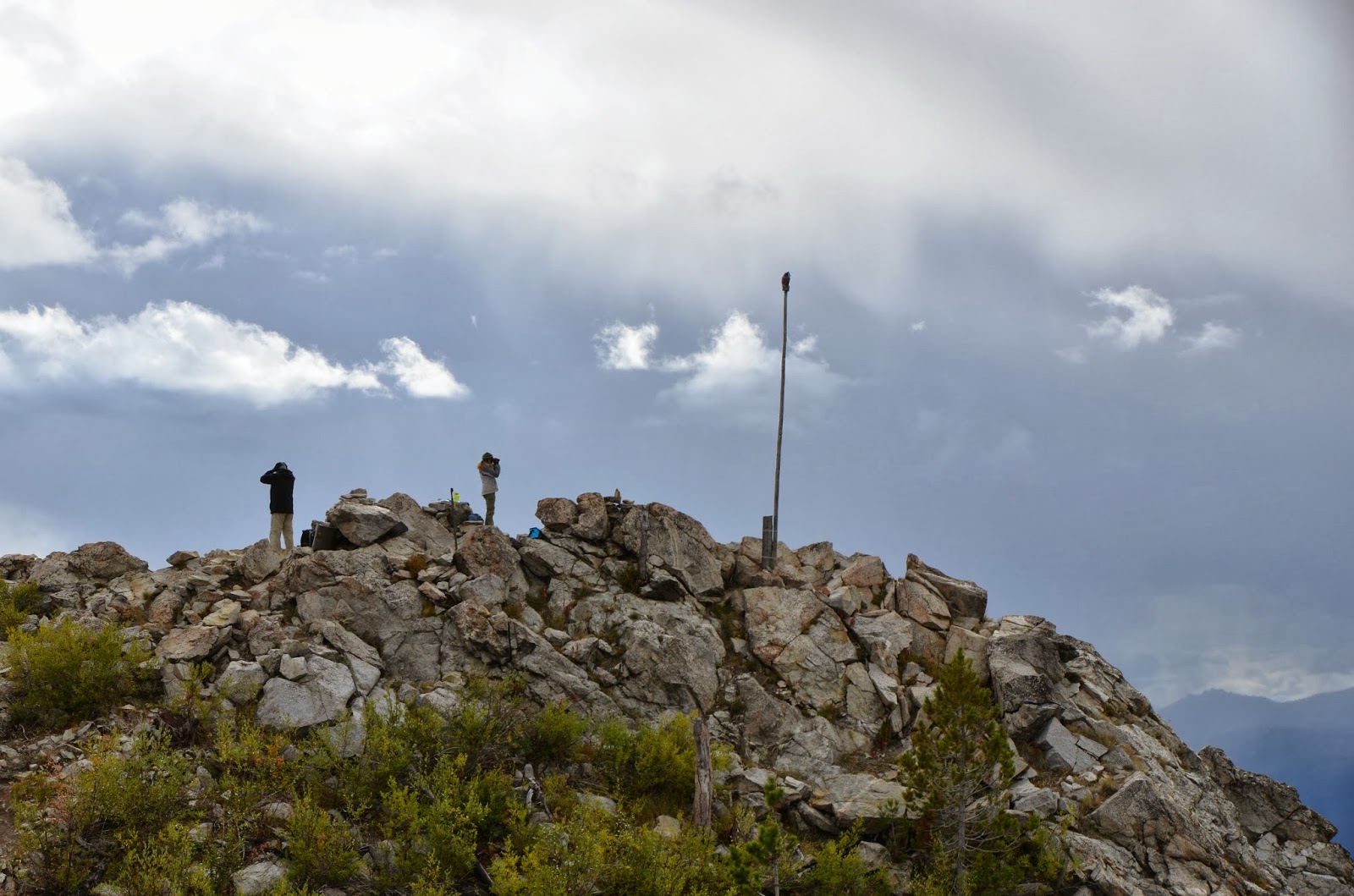
Chelan Ridge Hawk Migration Site at Copper Mountain
Last Thursday I put on my long underwear for the first time this fall.  I wasn't searching for the first patch of snow to ski on or trying to get to Cutthroat Pass on my mountain bike for one last time this season.  I was going to Chelan Ridge as part of a Methow Conservancy field trip to witness the great hawk migration that has been observed by Kent Woodruff and his field crew for the past 17 years.  As Kent will mention, it has actually been occurring for more than 17 years (maybe 17,000 years?), but we have only been observing and counting the birds as they begin their arduous journey in relatively recent times. 
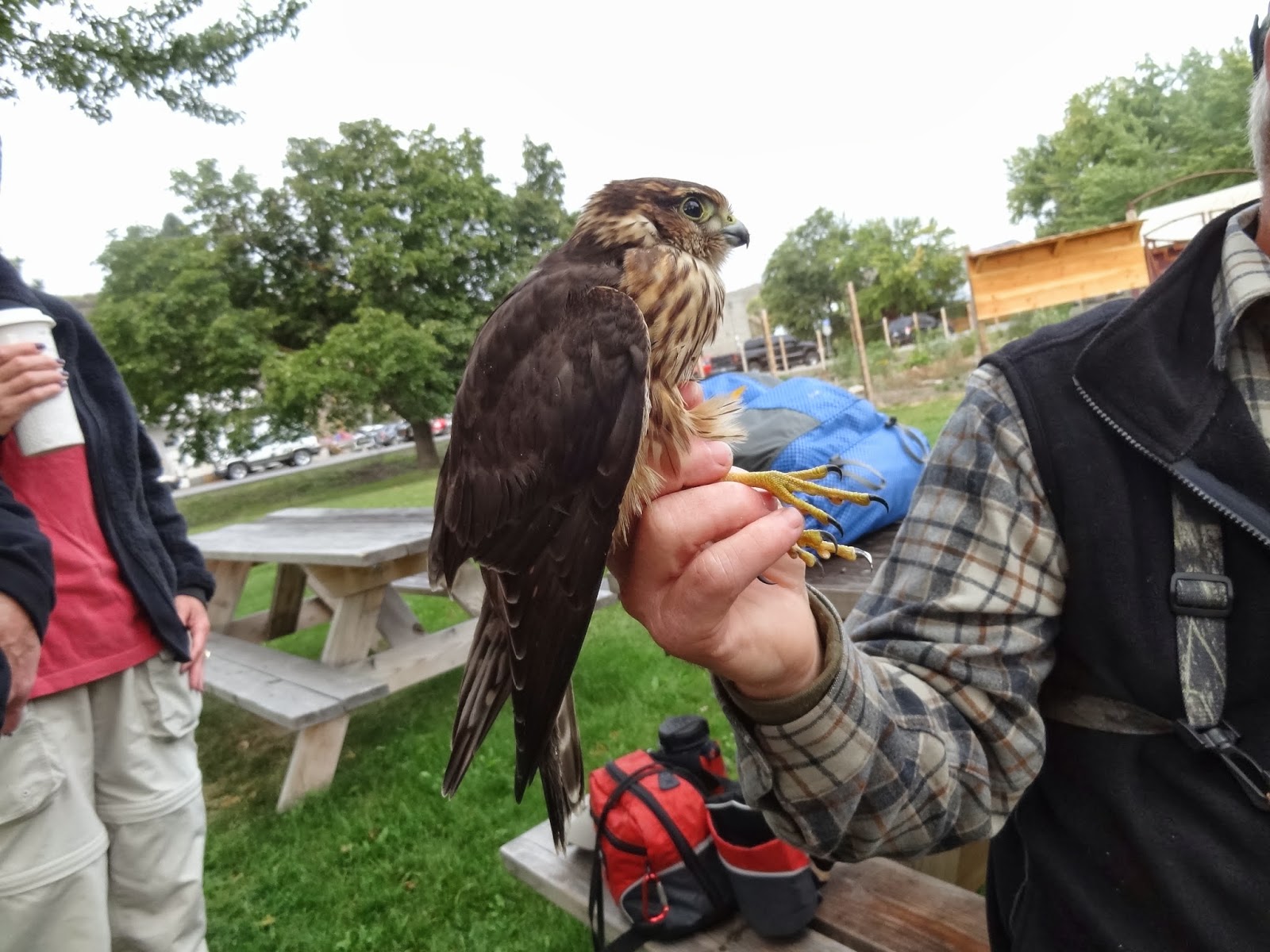
Jane's injured merlin found in a road.
The field trip had an unusual beginning with member Jane Gilbertsen showing up at the TwispWorks parking lot with a small cowering raptor in a cat carrier.  She had rescued what was determined to be an injured adult female merlin from the middle of East County Road.  Merlins are small falcons that inhabit northern forests and plains and are approximately the size of pigeons.  This particular merlin was a dark rich chocolate brown on its back and cap with brown streaks across her chest, which is typical coloring for the female.  A male would be more of a slate blue across his back and cap.  The little merlin was fed some fresh elk meat, which she ate voraciously.  She was ultimately sent in a convoy down to WSU to hopefully be rehabilitated by specialists. 

Following the winding bumpy Black Canyon Road up to Chelan Ridge at almost 6,000 feet in elevation, the tour began with a hike up towards the high observation points where biologists are staked out all day to identify and count individual birds.  After discussing the joint program between Hawkwatch International and the U.S. Forest Service that has collected invaluable qualitative and quantitative data about these birds, the group made its way towards the blinds.  There are two blinds on Chelan Ridge where other biologists utilize an intricate system of nets and lures to attract migrating hawks.  When hawks have been captured in the nests, valuable information is documented about not only their gender and species, but also their size and body condition.  They are banded around their leg with a metal band that has a uniquely coded stamp that can be interpreted through a database by any birders or biologists in North or South America.  
Chelan Ridge educator Carla Jo with a "sharpie"
The first bird captured in the blind on Thursday was a sharp-shinned hawk.  "Sharpies" are an accipiter and the smallest hawks to reside in North America.  Their preferred habitat is broad-leafed or coniferous forests.  Often mistaken for their larger cousin, the Cooper's hawk, the compact sharpies are the size of doves and fly with what looks like "shrugged shoulders". 
Carla Jo showing the wingspan of the northern goshawk
The final highlight of this exciting day came when the biologists in the blind presented a northern goshawk, a relatively uncommon bird to be caught on Chelan Ridge.  The goshawk is a very powerful raptor of northern forests.  Despite the fact that it is the largest of the accipiters, goshawks can fly with great agility through dense stands of trees, taking prey as large as snowshoe hares or merlins.  Northern goshawks are often used in falconry and revered in many cultures as a sign of strength.  Attila the Hun was claimed to have worn the image of a goshawk on his helmet.
It was a wonderful way to spend a fall day with Methow Conservancy supporters and the inspiring and committed biologists that are a part of the Chelan Ridge Hawk Watch project.  Their intimate knowlege of their subjects and their infectious attitudes as enthusiastic interpreters made our experience even more enjoyable.  

Fieldtrip participant, David, preparing to release a goshawk.

Fieldtrip participant, Helmet preparing to release a sharp-shinned hawk.