Tuesday, November 22, 2011
Snow!
The new pedestrian bridge on the Susie Stephens Trail here in downtown Winthrop provides a perfect vantage point for observing spawning salmon or simply watching the Methow and Chewuch Rivers come together during a peaceful snow storm like the one we are enjoying outside our office here in the Methow on Tuesday morning. The forecasters say that rain is one the way, but you wouldn't know that by looking outside. If you are here in the Methow Valley, enjoy! If you are headed to the Methow for the Thanksgiving Holiday, travel safely and have a wonderful weekend enjoying the beauty of the Methow Valley!


Wednesday, November 9, 2011
The White-Headed Salt Eagle Returns!

By Mary Kiesau, Conservancy bird nerd
Yes, we are into Latin or Scientific names around here, mostly because they are just so interesting, or maybe because it makes us look smart (or not so smart as the case may be with our last post from Jason who used the scientific name for Western Larch when he really meant to be referring to Subalpine Larch! We'll let him stick to running the organization). ANYWAY, today we are talking about the Bald Eagle with the fancy name of Haliaeetus leucocephalus. To decipher this we look to the Greeks where hali = salt, aeetus = eagle, leuco = white, cephalis = head. That's the white-headed salt eagle, or sea eagle as it is often called, but we'll stick to Bald Eagle today.
Have you noticed there has been a considerable increase in these big birds in the last week or so? In trees along the highway, in the rivers eating fish, flying low through the valley....yes, seasonal migration is on and eagles that spend their summers further north are returning here (their birth place) for the winter. (Some stay here year-round, but many more are here Nov-March).
Here's some info about Bald Eagles along with some local photos taken by yours truly:
Bald eagles historically occurred throughout the contiguous United States and Alaska. The largest North American breeding populations are in Alaska and Canada, but there are also significant bald eagle populations in the Great Lakes states, Florida, the Pacific Northwest, the Greater Yellowstone area, and the Chesapeake Bay region. In the fall, eagles begin moving to their wintering grounds, which can be throughout the US but mostly in the Midwest and West near open water and rivers, including the Methow Valley of course.


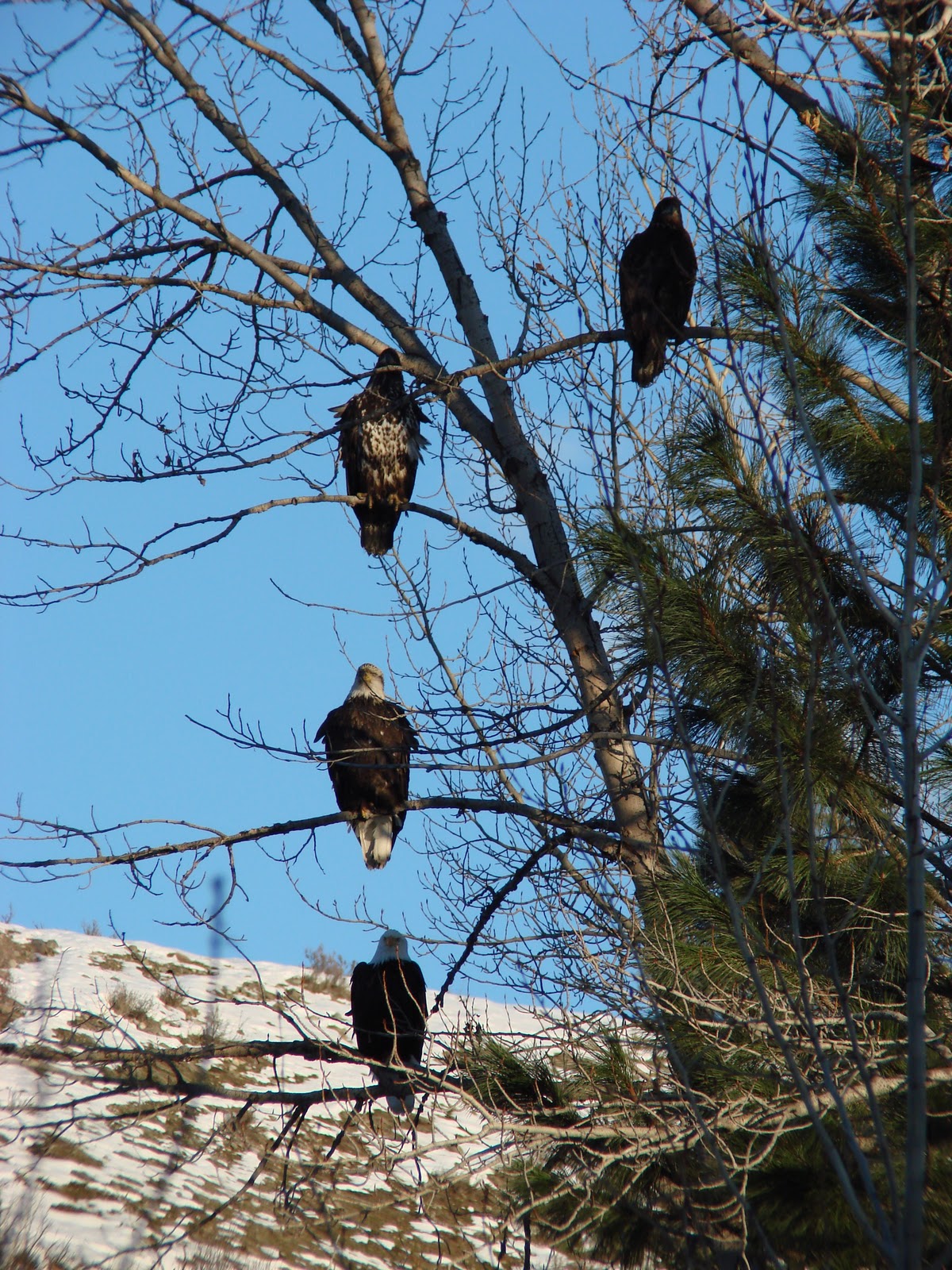
Eagles mate for life, typically nesting in the tops of large trees; nests may reach 10 feet across and weigh a half ton. The birds travel great distances but usually return to breeding grounds within 100 miles of where they were raised.
Breeding bald eagles typically lay one to three eggs once a year, and they hatch after about 35 days. The young eagles are flying within three months and are on their own about a month later. Young are as big as adults when they fledge – they gain 10 lbs in 10 weeks.
Female adults may weigh 14 lbs and have a wingspan of 8 feet. Male eagles are smaller, as is the case in many birds, weighing up to 10 pounds with a wingspan of 6 feet.
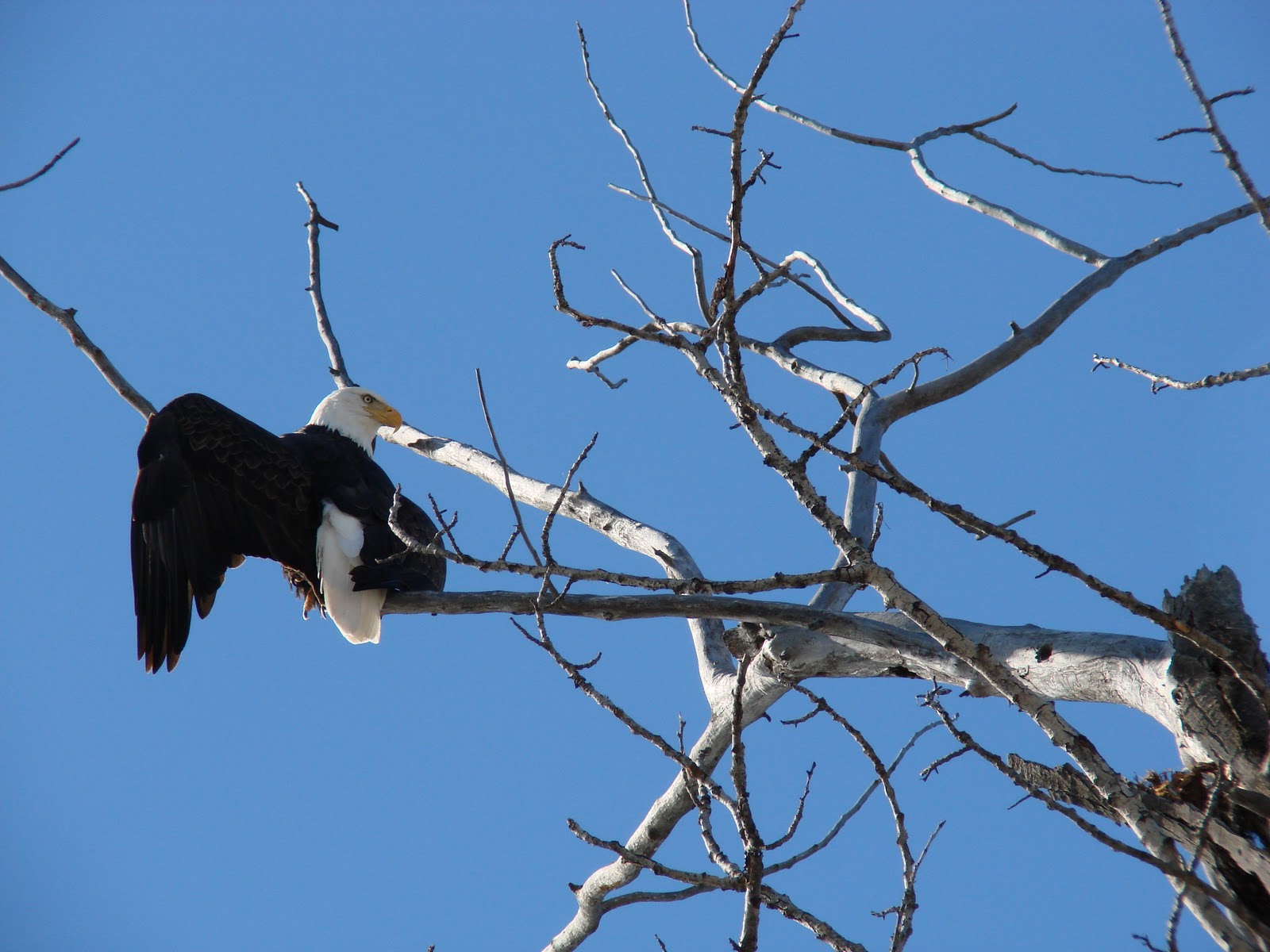
Bald eagles are opportunistic feeders with fish comprising much of their diet. They also eat waterfowl, shorebirds, small mammals, turtles, and carrion. Here in the Methow we often see eagles eating dead deer on roadsides or over embankments. Because they are visual hunters, eagles typically locate their prey from a conspicuous perch, or soaring flight, then swoop down and strike. Eagles need to eat about 11 lbs of food a day in the winter. Note the bloody face (and feet) of this eagle that was recently feeding on roadkill deer.

At night, wintering eagles often congregate at communal roost trees, in some cases traveling 32 miles or more from feeding areas to a roost site. It is thought that communal roasting helps the birds communicate and find food.

To distinguish Bald and Golden Eagles at any age, the lower part of the bald eagle’s legs are bare. The entire legs of golden eagles are feathered. Golden are noticeably larger as well, but for more of us the birds need to be side by side for us to "notice."
Bald eagles may live 15 to 25 years in the wild!
On June 28, 2007, the US Fish & Wildlife Service removed the Bald Eagle from the list of threatened and endangered species, and deemed it “recovered.” The bird is still protected by the Migratory Bird Treaty Act and the Bald and Golden Eagle Protection Act.


Happy Eagle Watching!
Monday, October 24, 2011
Larix occidentalis

By Jason Paulsen, Executive Director
Here in the "Evergreen State", fall is the time of year when the high country is illuminated with the beauty of Larix occidentalis, our "not so ever green" Evergreen.
Reportedly discovered in western Montana in 1806 and finally described and classified by Thomas Nuttal in 1834, Larix occidentalis or the western Larch is often a traffic stopper along Highway #20 near Washington Pass this time of year. And for good reason.

 While all conifers technically lose their needles, they do so over a cycle of 2 to 15 years, with the old needles being replaced by new green ones. For instance, most pines keep their needles for three or four years. Hence, their "ever green" appearance.
If you are here in the Methow Valley this week, be sure to plan a hike somewhere up high to enjoy the brilliant beauty of Larix occidentalis!
- Jason

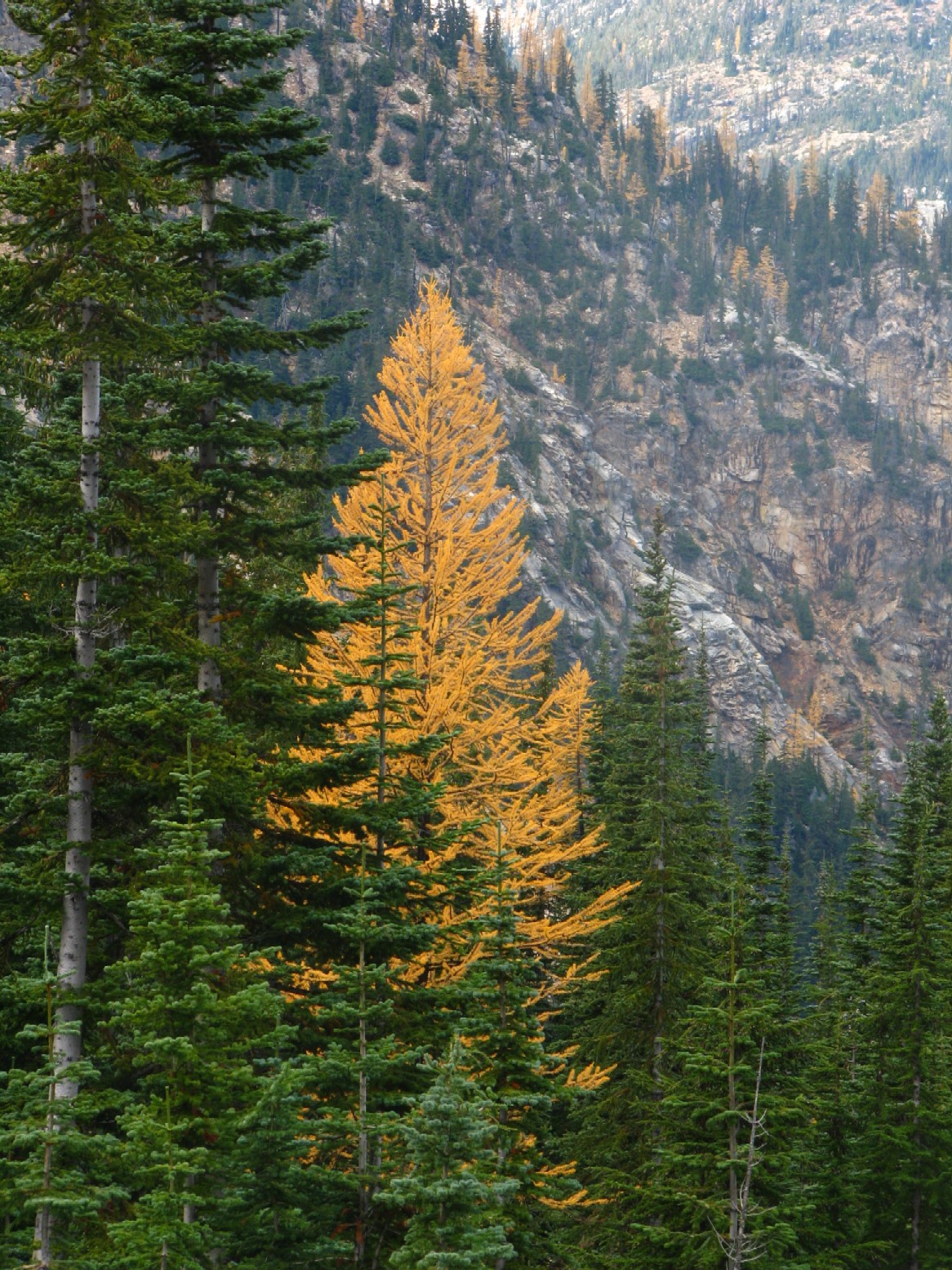


Photos by Jason Paulsen, 2011
Monday, October 17, 2011
Step Outside...
 One of the great things about the Methow Valley is the fact that you can literally step outside just about anywhere and be captivated by the beauty of the landscape -- even if you have only a few minutes.
 A short walk around our downtown Winthrop office this afternoon revealed beautiful fall colors, the crystal clear water at the conflence of the Chewuch and Methow rivers, and the whistle of air under the wings of a pair of ducks headed south.
 We welcome you to migrate through our Winthrop office when we are open, to say hello, and to enjoy the unique setting that provides so much inspiration for our work. We hope to see you soon!
 Enjoy!
- Jason


Wednesday, October 5, 2011
"My Favorite Time of Year..."
By Jason Paulsen, Executive Director

While not concluded by way of a scientific survey, I think that the period from mid-September through mid-October is the time of year when casual conversation here in the valley most often includes someone saying “…this is my favorite time of year.” Or, perhaps I’m just more receptive to these remarks because the autumn season is my favorite time of year.
Regardless, I was giving some thought the other day to why I feel such a strong connection to this time of year. Crisp mornings, clear blue sky days (at least some days!), less traffic on the trails, the beauty of the low angled light at sunrise and sunset, or the satisfaction of getting firewood secured for the coming winter…there’s no end to the list of great attributes that the autumn season brings.
For me it is all these things, and something more.
 |
| Harvest and views on a conserved property in Mazama |
While stacking firewood the other night, I concluded that it is the frequency of what I’ll call “memory triggered by scent” episodes that make this season so intense and enjoyable for me. Those moments where a scent in the air triggers an immediate memory, transporting me back to a previous time and place, often one I haven’t thought about for years. I seem to experience these episodes more frequently at this time of year for some reason.
Over the past couple of weeks, the smell of fresh cut alfalfa has taken me back decades to time spent on the tractor on my grandparent’s farm. The smell of fresh snow in the mountains brought back a memory of waking up unexpectedly to a snow covered tent near Mount Rainier . The first smell of wood smoke evoked memories of past Septembers spent smoking and canning salmon with my family. Even the smell of the skunk who met an untimely demise on Highway 20 near Big Valley the other day triggered a humorous memory of trying to evade a one of its cousins while camping last year in British Columbia
I hope to find some time this winter to research the science behind this “scent/ memory” connection, but until then I’m already looking forward to being outside this evening after a day of rain, to see what memories come drifting by. And I’ll look forward to hearing if any of you experience these “triggers” more often at any particular time of year?
- Jason

Tuesday, September 27, 2011
Behind the Scenes: The Sweetness of the Cider Squeeze


By Sarah Brooks, Associate Director
I still get nervous before our events. Are all the little details (and the big ones, for that matter) in place? What will happen that’s out of my control? What if no one shows? What if we don’t have enough food? What if…
Prepping for my 8th annual Cider Squeeze, it seemed I shouldn’t be too nervous. After all, it’s a great event every year: generous hosts Marilyn and Dave Sabold are about the nicest people you could meet, there is always plenty of tasty cider flowing from a cool antique press, the weather was set to be sunny and warm, and who doesn’t enjoy an excuse to enjoy a fall day at the Sabold’s beautiful pond?

And, so, I fretted most of Friday night and Saturday morning. What if others get stung ? What if no one wants to press the cider because of those pesky wasps? Here was an event wrinkle I had not anticipated.
The event began and soon enough the press was running. I must admit that I spent much of the following two hours thinking about all the details that could go awry. I saw lots of smiling faces and people seemed to be having a good time (and no medical emergencies emerged), but I still couldn’t seem to relax.

As the event drew to a close, Nellie Casey stopped by my nametag table to say thank you for the event. She then proceeded to say that she looks forward to the event because even if you don’t leave with cider, there’s just something about taking a turn on that press and looking up to see another community member working with you.
And suddenly, I stopped all that fretting. Nellie was completely right. That’s the point of the Cider Squeeze. It does take a whole team of people to make that sweet nectar: people to put the apples in the press, someone strong to spin the wheel, someone else to monitor the flow, another to crank the press, others to filter and fill the bottles. A whole crew of people—who often haven’t met before—have to work together.
That’s a pretty perfect metaphor for doing conservation work in the Methow. You can’t do it alone. It takes a whole team – a whole community—of people. And, it takes working with people you may not know for the end cause you all care about.

Thursday, September 22, 2011
RAPTORS up-close and personal
By Mary Kiesau, Program Coordinator
On Sept. 21, 2011, we took a fieldtrip to the Chelan Ridge Raptor Migration Project site with 12 folks. Just like last year's fieldtrip, we had an amazing day seeing raptors up-close and personal and learning about raptor conservation with our wonderful guide and instructor Kent Woodruff. We highly recommend a visit to this site which is open to the public daily. The raptor project usually runs from late August through mid to late October. Check out http://www.hawkwatch.org/conservation-science/migration-research-sites/74-chelan-ridge-raptor-migration-project for details on the site, including how many and what species of birds have been counted there. These photos were taken by Mary Kiesau.
 |
| A Sharp-Shinned Hawk at the Chelan Ridge Raptor Migration Project site. |
 |
| Kent Woodruff, Chelan Ridge project coordinator (works for the Forest Service) and a Sharp-Shinned Hawk. The FS works in partnership with HawkWatch International to monitor and learn more about raptors migrating through the eastern Cascade Mountains of Washington. The project has been running for 15 years. |
 |
| A female Sharp-Shinned Hawk, weighing in at 184 grams. A male caught earlier weighed just 91 grams. For raptors, females are always larger than males. |
 |
| Ellen Lamiman holding a Sharp-Shinned Hawk. |
 |
| Ellen Lamiman releasing a Sharp-Shinned Hawk. |
 |
| By looking at the faint colors within the wing of this Cooper's Hawk, Kent can tell that it is a "2nd year" (2 year old) bird. It still has a tiny bit of brown (juvenile) feathers in it's wings. |
 |
| A female Cooper's Hawk, weighing in at 453 grams. This bird was significantly larger than the Sharp-Shinned Hawk, but they are similar in that they are both Accipters. These birds are short-winged and long-tailed, and they are forest hunters. They are quick and agile, able to pursue small birds through trees and shrubs. |
 |
| The views and trail to the Observation Deck. |
 |
This is known at the Observation Deck. At least two people stand here all day watching for raptors and writing down info on what they see. A plastic owl, which raptors hate, on a pole helps bring raptors in, but it's the high density of willows on the ridge that brings in "food birds" (aka song birds) which in turn brings in raptors...much more here than other places. |
 |
| Kent Woodruff tells us about the beak of a Sharp-Shinned Hawk. |
 |
| Kent Woodruff, Chelan Ridge project coordinator (works for the Forest Service) and a juvenile Sharp-Shinned Hawk. |
 |
| Placing the very calm Sharp-Shinned Hawk in the hand of Heide Andersen, our Stewardship Director. |
 |
| Heide Andersen releasing the Sharp-Shinned Hawk. |
Subscribe to:
Posts (Atom)