From Frogs, Logs, Dogs, Slogs, Bogs, Hogs, and Pollywogs - It's the Methow Conservancy Blog!
Occasional posts - from the quirky to the momentous - on the life and times of the Methow Conservancy.
(What you won't find in E-News)

Friday, January 31, 2014

Bighorn Sheep of the Okanogan - Video & Notes from the Jan 2014 "First Tuesday"

Jeff Heinlen, WA Dept. of Fish and Wildlife Biologist, gave our January 2014 "First Tuesday" program.  Here is a video of the talk and some notes.  He talked about the cultural history, ecology and life history, and management issues associated with the Bighorn Sheep of Okanogan County.

The video starts about 10 minutes into his presentation and lasts 51 minutes.


Notes by volunteer Bob Herbert
The Methow Conservancy’s first First Tuesday lecture for the 2014 season was presented by Jeff Heinlen.  Jeff spoke to a packed Twisp River Pub crowd about the Bighorn Sheep of Okanogan County.  There are seven herds of Bighorn sheep currently located in and around Okanogan County.  Washington’s herds are divided between two species, the California Big Horn, and Rocky Mountain Big Horn sheep.  Females can grow to around 150 pounds and males can weigh up to 200 pounds, and they choose to live amongst the steepest cliffs they can find. 

Their habitat is their best protection, and their soft, split hooves provide them with the stability necessary to traverse narrow ledges.  Their hoof design is similar to the Mountain Goats of the North Cascades and Rocky Mountains, and they both escape predators by climbing out onto ledges that no other creature dare walk.  Unlike deer and elk, Big Horn sheep’s split hooves are spongy.  This allows them to grip the uneven surfaces of the rock ledges they are climbing.  Their soft hooves can be used to grip and pull themselves straight up vertical cliffs with strength of their front legs.  Their leg bones and joints are also designed with shock absorbers so they can withstand the impact of a twenty foot leap onto solid rock. 

Bighorn sheep are grass eating vegetarians, like deer and elk, but unlike deer and elk, who have antlers that are shed annually, bighorns have horns that they keep their whole lives.  The full shape of their curled horns takes seven to eight years to form and the rings on the horn are one of the ways in which to identify their age.  Their horns make up between 8-12% of their total weight and they are used for protection, as well as for sparring during the fall rut.  In the fall, the males will ram their heads together in order to determine the pecking order for mating purposes.  The rings on their horns represent a years worth of growth, just like the rings on a tree.  The first five years shows the fastest growth and the largest distance between rings.  As they get older, the rings grow closer and closer to one another.  Another way to determine the age of a sheep is to slice one of their teeth.  A cross-section of one of their molars reveals a ring for each year of growth. 

There were seven sub species of Bighorn sheep in the west, but one of them has gone extinct.  By 1935 the entire population of Bighorn sheep was either hunted to extinction (locally), or killed from disease brought over by domestic European sheep.  In 1957, eighteen Bighorn sheep were reintroduced from British Columbia into northern Washington State and they were allowed to reproduce and expand inside of protected pens during the 1960’s.  After they were released near the Canadian border, they spread out south and east over the Columbia basin, until they eventually established seven individual herds.  There are approximately 500-600 Bighorn Sheep currently living in and around Okanogan County, and we are lucky to live amongst these unique creatures! 


Monday, December 23, 2013

Wolverines, Grizzly Bears, and the Natural Power of Connections - Notes from the Dec 2013 Holiday Program


Doug Chadwick by Karen Reeves
By Volunteer Bob Herbert
The Methow Conservancy's December program was standing room only for the biologist and author Doug Chadwick.  Doug traveled from his home outside Glacier National Park and he shared with us his vast knowledge about two of North America’s fiercest predators.  Doug is an expert on wolverines and grizzlies, and the photographs and stories he shared were enthralling.  Both creatures play an important role in the food chain, and they both provide balance to the pristine Rocky Mountain wilderness they call home.  They live on the crown of the continent, and Doug showed us that the wolverine prefers the crests to the valleys, and they summit the tallest peaks before breakfast.

             
Chadwick & "Tank" snarling by Joel Sartore
There is approximately one grizzly bear for every five square miles, and they and the wolves are known as ‘keystone species.’  The Northern Rocky Mountains boast the largest and densest population of grizzlies on the planet.  The berries the bears eat are returned to the ecosystem in the form of fertilizer and seed, which insures a constant source of food for these magnificent creatures.  The digging bears do in order to find grubs helps to turn the soil over, which is why Doug referred to them as the gardeners of the mountains.  These bears are survivors and they are capable of living in extreme conditions.  We learned that there are thirty grizzlies that still remain in the harsh, arid climate of the Gobi desert. 

Wolverine by Steven Gnam
The grizzly bear is a powerful creature and it symbolizes the rugged wilderness of North America, but the stories Doug shared about the wolverine kept the audience’s jaws open in awe and utter respect for this elusive creature.  The wolverine hales from the same family as weasels and martins and they reside in the alpine and sub-alpine regions of North America.  They grow to around three feet in length and they weigh thirty pounds at maturity.  They have been known to take down moose and caribou, and they are fierce enough to drive grizzly bears off of a carcass.  They travel the most difficult routes possible, over the highest peaks in the area.  They travel straight up avalanche chutes and down the backside of mountains at a speed that is unattained by any other creature, and they do it with the endurance necessary to evade any predator.  One GPS tracking device showed how a wolverine climbed a vertical mile to the summit of a mountain and back down to the next valley in ninety minutes.  They did this in the middle of winter with heavy snow on the mountain.  For any Methow locals who would like to test their endurance and speed against the wolverine, you can replicate this feat by starting at the base of Last Chance Point, attaining the summit, and returning to the road that leads to Hart’s Pass in 90 minutes, in snowshoes, in February.
Captive wolverines by Dale Pedersen

Wolverine by Steven Gnam
Wolverines will dig through 20 feet of snow in order to find a marmot sleeping in a den.  They dig their own den in 10-12 feet of snow, and they will tunnel 20-50 feet horizontally, which is why global warming is threatening this rare species.  The only real competition the wolverine has for food is bacteria, and they have been known to return to cached food tens of miles away, months after the kill, in order to find a meal during the harsh winter months.  Wolverines will not tolerate temperatures over 70 degrees, which is why they make their homes in the most remote, glacier covered mountains of North America.  There were 110 glaciers in Glacier National Park when it was founded in 1910, but there are only 23 that remain today.  The reduction of possible den sites and feeding grounds means that wolverine habitat is disappearing faster than any other species in that ecosystem.  There is an estimated 35-45 wolverines living in an area that covers 1,500 square miles.  The same area contains approximately 150 grizzlies, so you can see how rare the wolverine really is.  The wolverine’s territory covers 200 square miles of the most rugged landscape on the continent, and it is estimated that only 300 remain in the lower 48 states.   

Thank you to Doug for sharing his knowledge, expertise, and humor with us. and thanks to the Methow Conservancy for bringing him here.  I’m sure that everyone who attended gained a healthy respect for the wolverine and the grizzly bear, and we are lucky enough to have a small wolverine population living in our side yard in the North Cascades. 

Friday, November 15, 2013

Storytelling for Change - Notes from the Nov 2013 "1st Tuesday"


By volunteer, Bob Herbert
The Methow Conservancy’s "First Tuesday" program for November was filled to capacity with people eager to learn more about our resident film makers Benjamin Drummond and Sara Joy Steele.  Benj and Sara have started a project called Facing Climate Change and it focuses on the affects that global warming is having on northwest communities and tribes.  They have adopted a short film format that focuses on how global warming and climate change is affecting people’s lives and their livelihoods.  The average length of their mindfully created productions is just over four minutes, which means they are able to distribute them through the many social media networks.  

"Oyster Farmers: Facing Climate Change"
The first film we watched spotlighted a family owned oyster farm that was forced to relocate their hatchery due to increasing acidity in the oceans.  It is estimated that 25% of the carbon dioxide that has been produced through the emission of greenhouse gases has been absorbed by the oceans.  The increased levels of CO2 have lowered the pH and it is happening faster than climatologists expected.  The acidity of the Puget Sound is actually increasing faster than other areas due to the strong ocean upwelling that occurs here.  The colder the water, the higher the concentration of CO2.  The owners watched their oyster spawn decrease year after year.  Young oysters were struggling to survive in the acidic water; in some cases their thin shells would dissolve.  The family finally made the decision to open a hatchery in Hilo, HI.  They knew the pH would continue to drop so they were forced to relocate their oyster farm to an area where the ocean is warmer and acidification has not had as big of an impact.  

Plateau Tribes: Facing Climate Change
The next film focused on the Umatilla tribe of northeastern Oregon.  The Umatilla tribe has made a commitment to maintain the purity and availability of the First Foods given to the Indian people of North America.  They live in the high plains and they dig the same roots and gather the same berries as did their ancestors.  To this day, the Umatilla serve the same roots, berries, and salmon in their long houses, in the same exact order in which they were received from the Creator countless generations ago.  They share the First Foods with their brothers and sisters in the animal kingdom and they have made a promise to preserve these sacred foods for all.  This may become increasingly more difficult with time however, as the temperature continues to climb here in the northwest.  The Umatilla fear that the roots and berries will be forced into higher elevations, or even become extinct, and the quantity and quality of salmon suffers when water temperature increases.  The boundaries of their reservation will not change with the climate, so the future of the Umatilla’s food source depends on whether or not the developed countries of the world are will to do the right thing and address climate change once and for all. 

Benjamin and Sara’s films tell a personal, localized story.  This format is an extremely effective way of getting a message across in a short amount of time, and the stories they tell should be heard by as many people as possible.  More details about their Facing Climate Change series (which also includes films about coastal tribes and potato farmers) is available to watch at their website - http://bdsjs.com/ - and I urge you to check them out.   

Sara and Benj also showed the audience two films in their work for TEAM Network, a global web of field stations that provide an early warning system for loss of biodiversity in tropical forests.  Badru's Story was an official selection at the Wild & Scenic Film Festival and was also shown at the Mountainfilm Festival.  

Our natural history-loving crowd got a kick out of Benj and Sara's unique interviews called "The Natural History Project."  See a short film and/or listen to 15 different interviews at the website.

Thanks again Sara Joy Steele and Benjamin Drummond for sharing your films and thank you for the tireless work you are doing for the planet and its inhabitants!

Tuesday, October 1, 2013

Learning about Raptors and their Migration at Chelan Ridge

By Heide Andersen, Stewardship Director
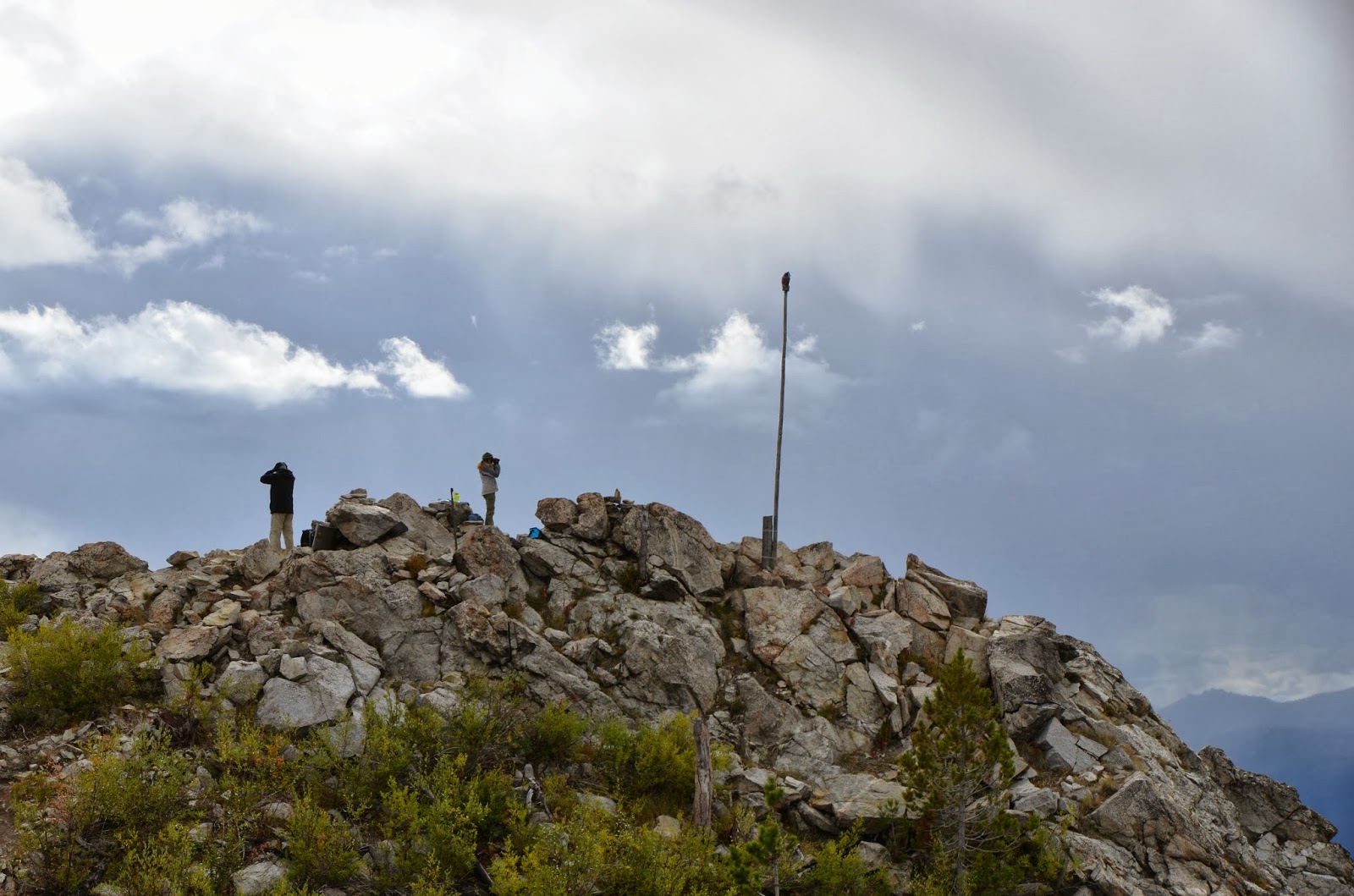
Chelan Ridge Hawk Migration Site at Copper Mountain
Last Thursday I put on my long underwear for the first time this fall.  I wasn't searching for the first patch of snow to ski on or trying to get to Cutthroat Pass on my mountain bike for one last time this season.  I was going to Chelan Ridge as part of a Methow Conservancy field trip to witness the great hawk migration that has been observed by Kent Woodruff and his field crew for the past 17 years.  As Kent will mention, it has actually been occurring for more than 17 years (maybe 17,000 years?), but we have only been observing and counting the birds as they begin their arduous journey in relatively recent times. 
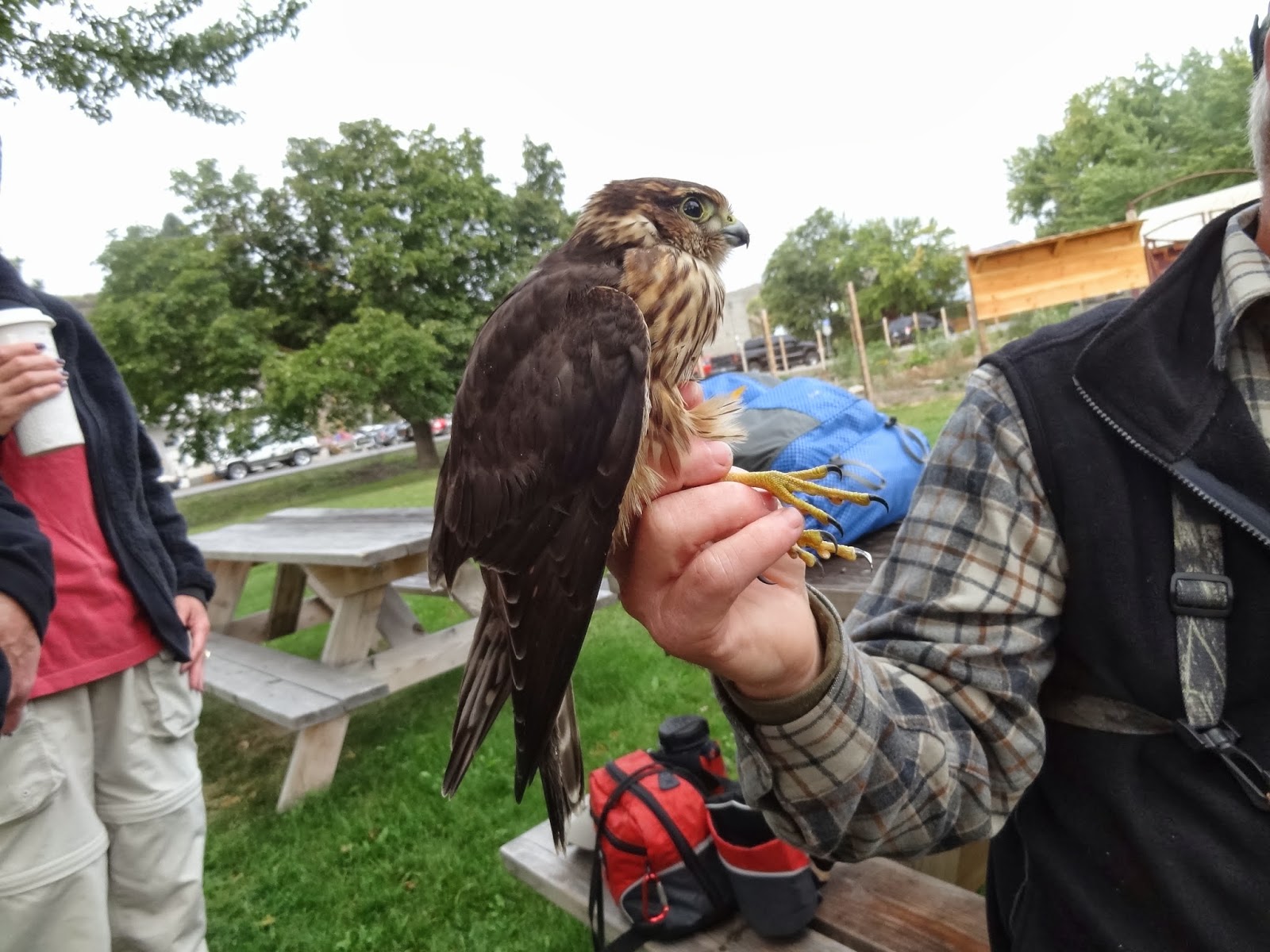
Jane's injured merlin found in a road.
The field trip had an unusual beginning with member Jane Gilbertsen showing up at the TwispWorks parking lot with a small cowering raptor in a cat carrier.  She had rescued what was determined to be an injured adult female merlin from the middle of East County Road.  Merlins are small falcons that inhabit northern forests and plains and are approximately the size of pigeons.  This particular merlin was a dark rich chocolate brown on its back and cap with brown streaks across her chest, which is typical coloring for the female.  A male would be more of a slate blue across his back and cap.  The little merlin was fed some fresh elk meat, which she ate voraciously.  She was ultimately sent in a convoy down to WSU to hopefully be rehabilitated by specialists. 

Following the winding bumpy Black Canyon Road up to Chelan Ridge at almost 6,000 feet in elevation, the tour began with a hike up towards the high observation points where biologists are staked out all day to identify and count individual birds.  After discussing the joint program between Hawkwatch International and the U.S. Forest Service that has collected invaluable qualitative and quantitative data about these birds, the group made its way towards the blinds.  There are two blinds on Chelan Ridge where other biologists utilize an intricate system of nets and lures to attract migrating hawks.  When hawks have been captured in the nests, valuable information is documented about not only their gender and species, but also their size and body condition.  They are banded around their leg with a metal band that has a uniquely coded stamp that can be interpreted through a database by any birders or biologists in North or South America.  
Chelan Ridge educator Carla Jo with a "sharpie"
The first bird captured in the blind on Thursday was a sharp-shinned hawk.  "Sharpies" are an accipiter and the smallest hawks to reside in North America.  Their preferred habitat is broad-leafed or coniferous forests.  Often mistaken for their larger cousin, the Cooper's hawk, the compact sharpies are the size of doves and fly with what looks like "shrugged shoulders". 
Carla Jo showing the wingspan of the northern goshawk
The final highlight of this exciting day came when the biologists in the blind presented a northern goshawk, a relatively uncommon bird to be caught on Chelan Ridge.  The goshawk is a very powerful raptor of northern forests.  Despite the fact that it is the largest of the accipiters, goshawks can fly with great agility through dense stands of trees, taking prey as large as snowshoe hares or merlins.  Northern goshawks are often used in falconry and revered in many cultures as a sign of strength.  Attila the Hun was claimed to have worn the image of a goshawk on his helmet.
It was a wonderful way to spend a fall day with Methow Conservancy supporters and the inspiring and committed biologists that are a part of the Chelan Ridge Hawk Watch project.  Their intimate knowlege of their subjects and their infectious attitudes as enthusiastic interpreters made our experience even more enjoyable.  

Fieldtrip participant, David, preparing to release a goshawk.

Fieldtrip participant, Helmet preparing to release a sharp-shinned hawk.

Tuesday, September 10, 2013

Whitefish Island - Fish Restoration & Snorkel Site!

by Mary Kiesau & John Crandall

On August 11, 2013 we took a field-trip to "Whitefish Island" with aquatic ecologist and Methow Monitoring Coordinator, John Crandall.  Whitefish Island, between Winthrop & Twisp along Hwy 20, is the site of a large-scale river restoration project implemented to improve habitat for ESA-listed (endangered or threatened) fish species inhabiting the Methow River.  Participants heard from John what was done at the stream habitat restoration site but more specifically why.  It's a long story but here are the basics, plus photos from the day!

Stream restoration is occurring to address landscape conditions (which are now degraded and lacking the "functionality" that creates diversity of habitat that supports a variety of fish species and life stages --eggs, juveniles, adults) - that limit the production of spring Chinook, steelhead and bull trout that are listed under the ESA.


Increased fish production is a necessary step (court mandated) to achieve recovery and get the species off the ESA. This is the ultimate goal of current habitat restoration efforts in the Methow.


Reconnection of stream with their floodplains and side channels, installation of large wood, and improving streamflow and water quality (riparian restoration) are key attributes of current restoration efforts. Habitat protections (easements etc.) assist this effort by keeping intact functional/less impacted areas.


Fish need habitat options as they move through their lives. Habitat/streams that provide a variety of water depths, current velocities and overhead/instream cover are the most productive. Stream restoration is occurring to provide the Methow watershed with increased stream function to create habitat over time (decades +) as well as shorter term additions of large wood that provide immediate habitat benefits for fish and other species.


Monitoring has shown that juvenile fish (ESA species and other species like lamprey) are abundant in the large wood structures that have been installed. The structures should increase juvenile fish growth and survival
which is being monitored through the MRC.


Wednesday, July 17, 2013

Beaver Match-Making? An Immersion into the Deep Trenches of Mammalian Harmony


Guy feeding beavers before they are relocated
By Guy Thyer, one of our three college interns
(To learn more about the Methow Beaver Project, click here)

The inexperienced beaver feeder might mistake their task to be a simple matter of putting food in the bowl. While we understand the importance of daily sustenance in these beaver’s lives, we’ve found the feeding process to be an immersion into deep trenches of mammalian harmony. More than simple nutrition, feeding the beavers is about fabricating stories of love, drama, and the eventual triumph of the Good and then playing them out to full fruition!

----

It’s a Monday afternoon. Jamie jumps out of the passenger side to unhook the fenced-gate and we pull into the Winthrop Fish Hatchery. We are quick to shelter ourselves from the shameless beaver courting; we interns of course, are much too young to see such voluptuous behavior. While millions of Americans eagerly await Episode four of the Bachelorette, where the men battle it out in the Bachelorette’s Mr. America contest, a much more subtle and arranged lover’s game is happening all the while down at the Winthrop Fish Hatchery.

Less the Bachelorette’s abs and interviews, sprinkle a touch more real-life drama, and you’ve got the Beaver Relocation project. Beavers are captured from at-risk locations and brought to their temporary home in Winthrop. The beaver-crew plays ultimate match maker; before the beavers can make the move to their new homes upriver they must find a partner. These naive lovers are tossed into pools and the mix-and-match is on. A quick date to the waterway-waterfall, a romantic cruise around the house, a wood-chewing project, or perhaps an afternoon of snuggling and whispering sweet nothings. No matter the activity, the waterways are lively, full of discovery and also occasional divergence. Feeding the beavers can be bittersweet, we interns are bludgeoned with redirected beaver stress from crushes, heartbreak, jealousy, and even foul rumors. We got tail-smashed (an epic and radical water-slap move) trying to photograph a beaver for this post. The social-spectacle of these raceways often approaches middle school dance levels.

Mama beaver and two youngsters
Arranged marriage within such a small population of beavers forces these water-wizards to look deep inside one another’s soul in search of redeeming qualities. Two dens are provided for each pair, so when it’s not all kittens-n-roses for the unfettered romantics, each has their own home. Unlike the bachelorette, these beavers hardly get a say in their new partnership. A testament to their starry-eyed spirit, grandmothers and spry teenagers, princesses and slobs, introverts and social butterflies find ways to fuse together into dynamic pairings. Sleep and play patterns are observed, all to ensure that each beaver has a fighting chance at the wonders and endless fruits of proper matrimony.

Getting released into a high mountain pond
No beaver, fat, small, shy or impatient is a forlorn partner. Stories ofcompanionship, compassion, and canoodling are abound and plentiful in these concrete condominiums. It is not heartbreak, but instead transcendent union that triumphs in the waterways. A proper cardiologist would shut down the entire operation for its extreme effects on the heart! When two beavers do truly connect, we find joy not only in that same encouraging sentiment that keeps America watching the Bachelor -- “two strangers can find love!” we yell at the Television/Waterway – but also in the return to the river that love symbolizes. More than just a relocation project, this is a project about the triumph of the beaver spirit. A mini-verse where cooperation, trust, and openness triumph over deceit, division and despair.   

Guy Thyer's Bio:
I am originally a Seattle-lad but I am going to be a sophomore at Pomona College in California this fall. I am an Environmental Analysis and Philosophy double major.  I am interested in education policy and ways of incorporating experiential/outdoor education into our education systems. I came to the Conservancy because the projects we are working on seemed really interesting and worthwhile. The tasks we work on are a great mix of environmental and community work. The people at the Conservancy, and in the Methow Valley in general, have been extremely impressive and have really inspired me to continue pursuing this sort of work! 

Thursday, July 11, 2013

Climate Solutions in the Age of Consequences - Notes & Video from the July First Tuesday

Notes by high-school intern Erik Ellis
Video (1 hour 20 minutes, see below) by high-school intern Ella Hall.

The July 2013 First Tuesday Program featured speaker KC Golden, from Climate Solutions, presenting a lecture entitled Climate Solutions in the Age of Consequences at the Merc Playhouse in Twisp.

Video of KC Golden Climate Solutions Talk

The first topic that was presented was that climate change is not just an environmental issue, that  it affects mostly every aspect of our lives, economic and social effects included. This means that we need to limit the adverse impacts of our society, and we need to clean things up a bit. This issue is too small to solve by just changing some aspects of our lifestyle. It requires complete, innovative re-engineering to build stronger, healthier, more compatible communities. A success story in Washington regards the Coal Plant, which produced 10% of Washington’s carbon emissions. In 2011, plans to phase out of coal passed with unanimous support from workers, company, and community. This was one of the biggest energy success stories, as it saved 5 Seattle-sized cities worth of power and $2 billion in electrical bills.

A Time Magazine headline from read “Be Worried, Be Very Worried.”  But the time to be worried was approximately 100 years ago when the first theories on carbon emissions came out. Changing ourselves and doing something about our impact on the environment is NOT optional, it is something that we have to do. What we are facing is either an inconvenient truth or a reassuring lie, and the truth does not lie in the middle of the two extremes. Right now everything is at stake, and if we continue on our current path, we will soon be likely to be beyond adaptation, so something must be done.
  
It is time to be the solution. Although this is a global scale, much of the impacts are local. For example, snow cover is projected to drastically decline. Forest disturbance will occur and at the end of the 21st Century there will be twice as much forest burned in Washington as in the 20th Century.  Sea level rise presents a problem. With just a 1 foot rise of sea level, an event like Hurricane Sandy, which may only occur every 100 years, becomes a once in 10 years event. With a rise of 2 feet, that even will happen yearly. Ocean acidification is rising, it is at 30% now but expected to be at 100-150% by 2100.

The problem is a cycle. Many people face this challenge with denial and confusion, which leads to inaction. We need to break this and turn this into a circle of practical economic solutions leading to results-oriented policies. Although it is called “Global Warming” much of the action must be local. By 2017, continuing with no action taken to stop this, emissions will be “locked in” and it will be increasingly harder to turn back. The Keystone Principle presents one answer: Stop Making it Irrevocably Worse!  Huge long-term mistakes we have the opportunity to not make. Clean Energy Revolution is good for us, but bad for the coal industries, who are turning to building coal plants in less developed countries. This can lead to a great climate disruption if it isn’t stopped.   

This is a technological and moral issue. A solution is to transition out of fossil fuels to more renewable resources. Also using biocarbon and scaling up carbon storage, taking back some of the carbon we’ve released. This leads to a bioeconomy. In the May 10th issue of the New York Times, it was being described as “game over for climate.” It isn’t a game, and it isn’t over. Adaptation and resilience is a must, limits on carbon pollutions, energy efficiency and renewables, international leadership, will help to tell everyone that someone’s doing something about it.

Helpful websites:
climatesolutions.org
powerpastcoal.com
Stop keystone XL: 350.org
Divest: Gofossilfree.org