From Frogs, Logs, Dogs, Slogs, Bogs, Hogs, and Pollywogs - It's the Methow Conservancy Blog!
Occasional posts - from the quirky to the momentous - on the life and times of the Methow Conservancy.
(What you won't find in E-News)
Showing posts with label grad school. Show all posts

Monday, August 3, 2015

Mary's Grad School Update #6

by Mary Kiesau, Methow Conservancy Educational Programs Director
It's been many months since I posted an update about my grad school work.  I've been back in the Methow and at work at the Conservancy since the middle of March, but every week I get questions about whether I've finished school, whether I'm still commuting to Bellingham, when I'll be done, etc., so I figured a quick update might be worthwhile.  

Plus, I have some fun photos to share!

This spring and summer I've continued to complete credits toward a Masters of Education in Environmental Education through some field-based programs.  In the spring, I helped off and on to "TA" (assisted in teaching) the undergraduate environmental education (EE) "spring block" course.  I would spend time with the undergraduates (which ranged in age from 19-34) intermittently - a week here, a week there, usually in the field such as on Sucia Island in the San Juans, or backpacking outside of Stehekin.  While I did prepare materials for the students, and do some instructing, much of my work was to provide guidance and feedback from a distance -- all while learning and practicing more EE skills myself.  I found my role/task both difficult because I wasn’t fully engaged and was often out of the loop with the other instructors, and extremely interesting and rewarding working with the undergrads and having a view-from-afar perspective.  I enjoyed watching things unfold and develop - people’s teaching skills and the overall group dynamics - while not being heavily involved in either instigating or supervising/debriefing/judging the students.  I was really able to focus on what I was comfortable with and skilled at, as well as see what I'd like to build and practice in myself.

Then, in late June and early July, I took part in an 18-day "Northern Field Botany" course. The course was offered through Western WA University's Biology department and I was able to take it as an elective for my M.Ed. program. Four undergrads, myself and the instructor stuffed ourselves into a rented Suburban with camping gear, food and enormous plant presses. We traveled everyday, hiked and collected plants most days, and saw an amazing amount of the vast British Columbia and Yukon landscape. It was incredible. Below are just a few of my 1400 or so photos!

As we head into fall, I'll begin work on my independent Master's Project (in lieu of a thesis).  I have a few options I'm tossing around now, but I'll settle into the work soon and focus on it through the winter (and continue to work at the MC full-time).  If all goes as planned, I will finish and graduate in March 2016.  All of this final project work will be done from the Methow.  All my other coursework is done and I do not need to attend classes on campus anymore.  
Salmon Glacier north of Hyder, Alaska

Pressed plants everyday.  Saxifraga tricuspida here.


Saxifraga tricuspida leaves
Saxifraga tricuspida, a type of Spotted Saxifrage

Just part of one hike's loot. We were collecting for the WWU herbarium as well as for DNA/genome research.

Sparrow's Egg Lady's-slipper - Cypripedium passerinum
Lapie Canyon, Yukon
Mary & a life-size Pleistocene era "Giant Beaver" at the Beringia Interpretive Center in Whitehorse, Yukon.
Dryas drummondi
The Carcross "desert" in the Yukon

Muncho Lake, BC


Keno Hill, Yukon - a nunatak that is beautiful when not socked in

Abundant black bears but never got a great photo of any

The Common Loon was on every lake, and everyday there were lakes

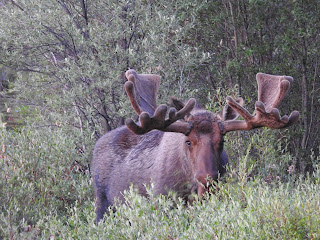
Lovely moose lady.  Such a beautiful and bizarre looking creature.

Momma "cross fox," a color variant of the red fox

Baby "cross fox"
Tombstone Territorial Park, Yukon
*Huge* grizzly while hiking in Tombstone (this is around midnight!)
Bistort
"Hiking the Midnight Sun" selfie in Tombstone

 
browsing willows at 2am

55° and drizzle in the Yukon while it was 100° at home
One of two huge and full plant presses


Many moose and many lakes in Canada!

The enormous "Wood Bison" - crazy huge and all over the roads

One of our best wildlife sightings - a wolf (seen through wildfire smoke at 10pm)

Stone Sheep, a subspecies of Dall sheep

Scaling mtns for tiny plants (Muncho Lakes/Stone Mtn area)
Porcupine Caribou in the Muncho Lakes/Stone Mtn area
Campanula
Prickly Pear (in Alberta!)
Sunset looking into Jasper Nat'l Park
Pyramid Peak in Jasper Nat'l Park


The End!

Saturday, February 28, 2015

Mary's Grad School Update #5

by Mary Kiesau, Methow Conservancy Educational Programs Director
  
My time in Bellingham is coming to a close soon, and I'll be back in the Methow full-time in a couple more weeks!  I'll continue to work on projects for my Masters in Education throughout 2015, but I will not have to commute regularly to Bellingham anymore. 

This quarter was been demanding and time-consuming with a lot of very "real world" project work in curricula building, lesson plans, evaluation, data analysis, assessment of learning, essay writing, and more.  Sounds very exciting, right?  Well, it's not exactly fun, but I have been totally engaged, and I feel very fortunate to be able to apply much of what I learn and think about directly to the Methow Conservancy (and my interests) and create graduate school projects that serve the Conservancy.  I love being able to serve multiple purposes!

Currently, I'm working on a large curriculum project on the natural history of the Methow.  It will need a lot more work (and programmatic details) before it might ever be put into practice, but it's a fascinating exercise to think about what to include, what the objectives would be, how to evaluate people, and how to create lesson plans.  

For another course, a fellow graduate student and I conducted 16 one-on-one interviews for a possible assessment/evaluation of the Methow Conservancy's education programs.  A combination of staff, Board members, volunteers and class instructors were interviewed.  They provided insight, suggestions and concerns that will be extremely useful to the Methow Conservancy broadly and with regards to its educational work.  

What makes an assessment fair and valid?
Lately, I've had to teach classes of undergraduates, which is both fun and terrifying for me.  This past week I lead an hour-long session on "Assessment of Learning," where I talked about why and how diagnostic, formative and summative assessments can be done, indoors and outdoors, formal and informal.  A few weeks ago, had someone asked me what these terms meant I would have starred back blankly.  One of the best ways to learn something is to teach it, as the saying goes!

This coming week, I'm "teaching" a nearly two-hour class on "New Directions in Nature Writing and Emerging Authors" to the American Literature of Nature & Place class, in which I'm normally a student. 
Prairie-star will bloom within the month!

With two big projects to finish and two more papers to write, the next two weeks are going to be a blur of long nights and fresh coffee, but I do enjoy the work and feel like the whole experience has been extremely worthwhile and thought-provoking.  Still, I can't wait to be back in the Methow and to go on my first hunt for spring wildflowers!

Saturday, January 31, 2015

The 2nd Quarter Begins - Grad School Update #4

by Mary Kiesau, Methow Conservancy Educational Programs Director

As many of you know, I started a Masters of Education in Environmental Education degree program at Huxley College at Western Washington University last fall.  The second 10-week quarter (and the last one I have to spend on campus) started Jan 6, so I'm well into the thick of things now.  (Scroll down the blog for three posts from the first quarter.).  

I'm in Bellingham 3-4 days a week, and am, oddly, getting significantly more sun over there than folks in the Methow.  Spring seems nearly ready to sprout in B'ham with cottonwood buds already sticky and sweet-smelling, and 2" long alder catkins hanging from trees.  I wouldn't be surprised if crocuses started blooming any day.  Coming back to my snow and ice covered yard every week is both very weird and welcomed because despite enjoying walking to campus without a coat, I miss winter when I'm over there.  

This program is set-up relatively well for working professionals in that I only have to do two 10-week quarters on campus, then the rest of the program is independent, including the Masters project, and I'll complete that work in the Methow and in-conjunction, as much as possible at least, with the Methow Conservancy.

Though the fall quarter felt fairly demanding time-wise, this winter quarter felt more intense right off the bat.  The professors must have been easing us into things in the fall!  I have the same number of classes as last quarter - three - but I'm also a "teaching assistant" (TA) for the unique environmental education "spring block" that about 20 undergrads do.  So, technically I'm taking 15 graduate credits this quarter, versus last quarter's 11, so maybe that's why I feel like I have much more to do.  Spending about 11 hours in a car commuting every week certainly cuts into my time as well, but at least I'm getting some great books listened to!  (Recommendations are always appreciated!)

My classes this quarter are:
Assessment, Evaluation and Research in Environmental Education
This course combines a major evaluation planning project with lecture, discussion, activities, and smaller assignments to teach concepts and skills emphasizing program evaluation in environmental education.  The evaluation planning project I've chosen to do is an assessment of the Conservancy's education programs with an eye towards what changes or enhances, if any, may be warranted based on community feedback.  This class is very reading and project heavy, and I'm glad to be apply to directly apply the learning and the project work to the Methow Conservancy. 


Curriculum in Environmental Education
This course examines all aspects of curriculum for environmental education, especially
in the non-formal setting of environmental learning centers, nature centers and outdoor schools.  This class interacts with the undergrad EE curriculum class by teaching the class, observing and evaluating undergrad students, and mentoring them.  We also do our own work of learning curriculum theories and designs, which we'll use to design our own individual curriculum outlines.  We'll have to teach one lesson from our curriculum to our classmates.  I'm thrilled that this class, like the one above, allows me to easily apply the learning and the curriculum project to my work. 


The American Literature of Nature and Place
This class is an upper level undergraduate course that I'm taking as an elective.  I'm one of two grad students in the class with about 25 20-year-olds.  That alone is fascinating!  The reading and writing in this class is right up my alley, but it is a lot of work.  I probably spend more time on this class, the undergrad class, than the either of the other two classes.  In this class, we primarily (1) read, discuss and write about the work of American non-fiction writers of nature and sense of place, and (2) practice descriptive and expository nature writing, critical reading and research.  I alone will also be teaching one class (about which I'm terrified).  I'm going to teach on “Future Directions in Nature Writing and Emerging Voices.”  If you have any ideas for my class (format, readings, activities...), I'm all ears!  We are required to read:
* Winter Creek by John Daniel
* The Meadow by James Galvin
* Refuge by Terry Tempest  Williams
* Riverwalking by Kathleen Moore
* and then one other book from a list, from which I choose The Immense Journey by Loren Eiseley  

I'm still managing to keep up with Methow Conservancy work, though you aren't seeing me at First Tuesdays or in the office much.  You can find me there some Thursdays and most Fridays, and I'll be back to a fairly normal office routine by mid-March.  Time flies!    
 

Sunday, November 30, 2014

A Calendar to Reconnect Relationships to Earth - M.Ed. Grad School Update #3

by Mary Kiesau, Methow Conservancy Educational Programs Director

The first quarter of my Masters of Education in Environmental Education program is quickly coming to a close and I'm feverishly finalizing two papers - one a discourse analysis on the "language of conservation" and one an examination and critique of Paul Kingsnorth's writings about “Dark Ecology.”

January
A project that I recently finished is what I'd like to share today.  The project asked us to define environmental education, envision its future, and describe our personal philosophy of it.  We could write a paper or create some other form of medium.  One person created a website.  I created a 12-month wall calendar (yes, ready to hang and use).

The calendar was called "Themes & Seasons of Environmental Education: Reconnecting Relationships to Earth," and here's some of what I wrote, plus the photos and captions (scroll over the image for the caption).
February


This calendar showcases many forms of environmental education, and represents the flow and motion of time inherent in education. Education, especially ecologically-centered education, is constant and growing; it is not a static cycle. The “seasons” of environmental education are represented in this calendar in
the following way:
  • New Year/winter: rebirth/renewal/awakening. It is a time for observing, listening
    March
    and quiet self-education as we begin to re-emerge for new or expanded growth. 
  • Spring: blossoming/growing/creating/learning. This is an active time of exploring and learning. We are eager and engaged. 
  • Summer: establishing/sharing/forming/bonding. Now we’ve transitioned to a time of establishing our knowledge and feelings by sharing them with others. Shared experiences enhance our education, and we begin to build community. 
  • Fall: reflecting/harvesting/nesting in “home” and place. As our education evolves, we need time to reflect and assess, which allows for expressing ourselves,and we start to dig deeper into both our connections to the world and our place and time in it. We realize there is still a lot to learn to be fully ecologically aware and connected. 
    April
  • End of year/winter: incorporating/tying up loose ends/celebrating/giving back. This is a time when we look both back and forward to come full circle and find wholeness in our lives. Now, we work to incorporate environmental education into all aspects of our lives so that it’s not even “environmental education” anymore but simply education paired with personal growth, sustainability and community. 

May
I believe environmental education is a dynamic process that should result in ecocentric behavior, values and beliefs. The process is between a “teacher” and a “learner,” where the learner could be the teacher and where the teacher could be any number of things from which we learn: experience, person, plant, animal, earth, history, conversation, etc. While environmental education is often centered in nature study, science and conservation education, and outdoor education, there is not one set way to do environmental education. Environmental education is not static and unchanging. It’s not a set of practices or a prescription but a mode of operating, a lens through which life is seen. There are no starting and
June
stopping points, and it is always growing and evolving for learner/teacher, building on the past and creating a path into the futurewhere nature has intrinsic value and where people value and act on their interconnectedness with all human and non-human life. The environmental educator’s job is to help themselves and others discover, understand and explore their place and relationship in and with the natural world.


July
While huge strides have been made in environmental education, I believe, like educator David Orr, that there is both a global ecological crisis as well as an educational crisis happening right now. Environmental education should not only be an aspect of science class or outdoor education, or a course in college; it must stop being viewed as a separate and specific topic for certain “educators,” and start being incorporated into the social fabric and conscious-raising of people from age zero upwards in all the places humans live. “The crisis we face, Orr explains, is one of mind, perception, and values. It is, first and foremost, an educational challenge” (Island Press). The upshot is that for the long-term health and survival of humans and all life on earth as we
August
know it, nothing short of an ecocentric educational revolution is needed. Everything else, and the bulk of what most “environmental educators” have been doing, is just window dressing in that it looks and feels good but isn’t making any significant changes in the world. Look at nearly any ecological or human health statistic and you’ll see that things
are getting worse. Environmental education, which must be holistically and strategically incorporated into all forms of school, must also reach beyond

September
children and schools to adults. How? If I knew, I’d be doing it. One thing that will help is to acknowledge and share with each other our fears and sense that something is missing, and tap into our compassion and empathy for all forms of life (human and non-human). In doing this, we will create more honest dialogue with each other. Along with re-thinking and re-organizing schools and curricula with an ecological and interconnected paradigm, we need to increase and enrich conversation and discourse. We need to create new stories that envision a functional future for all life.


Mary Kiesau,

October
observer, learner, naturalist, educator, earthling


November

December