Our 2018 "Conservation Course" started February 12th with an introductory class by Professor Dan Beck. Below are notes taken by Kristen Kirkby. See notes and videos from the previous classes here:
Class #1 - Herpetology Overview
Class #2 - Methow Reptiles
Learn more about the Herp Course here
Class #3 -Methow Amphibians with Julie Grialou & Amphibian Disease and Toxicology with Jenn Zajac, March 5, 2018
Watch and listen to the 2 hour lecture portion of the class on this video
Terms
Amphibios = double life. Amphibians lead a double life with aquatic larvae (juveniles) and terrestrial adults (but there are exceptions to this rule). This characteristics allows amphibians to exploit different habitats over their life history.
Heterochrony means that an animals life history and development timing can be fairly "plastic." They change over time and can change as a response to things in the environment.
Neotenic is a term used for larvae amphibians who have become sexually mature - they never look like "adults."
Amphibs can absorb water and oxygen through their skin, allowing them to burrow into soils in relatively arid environments and find sufficient water. With the skin as a respiratory organ, some don’t even have lungs (e.g. lungless salamanders)
Anuran (Frogs and Toads)
5892 species in 38 families
Characteristics: No tail, diverse reproduction strategies, metamorphosis from larvae to adults, fused caudal vertebrae aid in jumping, stabilizing the pelvis, also have adaptations to capture prey (e.g. saliva)
Frog saliva is viscous like honey, super sticky, but it liquifies when it hits prey so that it covers them, then becomes more viscous to capture them and bring back into the mouth, then liquifies again for swallowing.
Amplexus is the mating position of frogs and toads. In water, the male clasps the female from the back and holds on while the female releases eggs. The male then releases sperm and the eggs are fertilized external (in the water).
Frogs make rounded egg masses, toads make long stringy ones
The Pacific Northwest has 5 families of frog/toads. They are:
Ascaphidae – Tailed frogs
Ancient family; endemic to NW; highly aquatic; “tails” are reproductive organ. Tadpoles are like one big sucker mouth, which they use to cling to substrates in fast-moving water in headwater streams where they eat algae off the rocks.
In our NW region:
~ Pacific tailed frog (Ascaphus truei) (here in the Methow)
~ Rocky mountain tailed frog
Pelobatidae / Scaphiopodidae – Spadefoots
 |
| Great Basin Spadefoot |
In NW:
~ Couch’s spadefoot (Scaphiopus couchi)
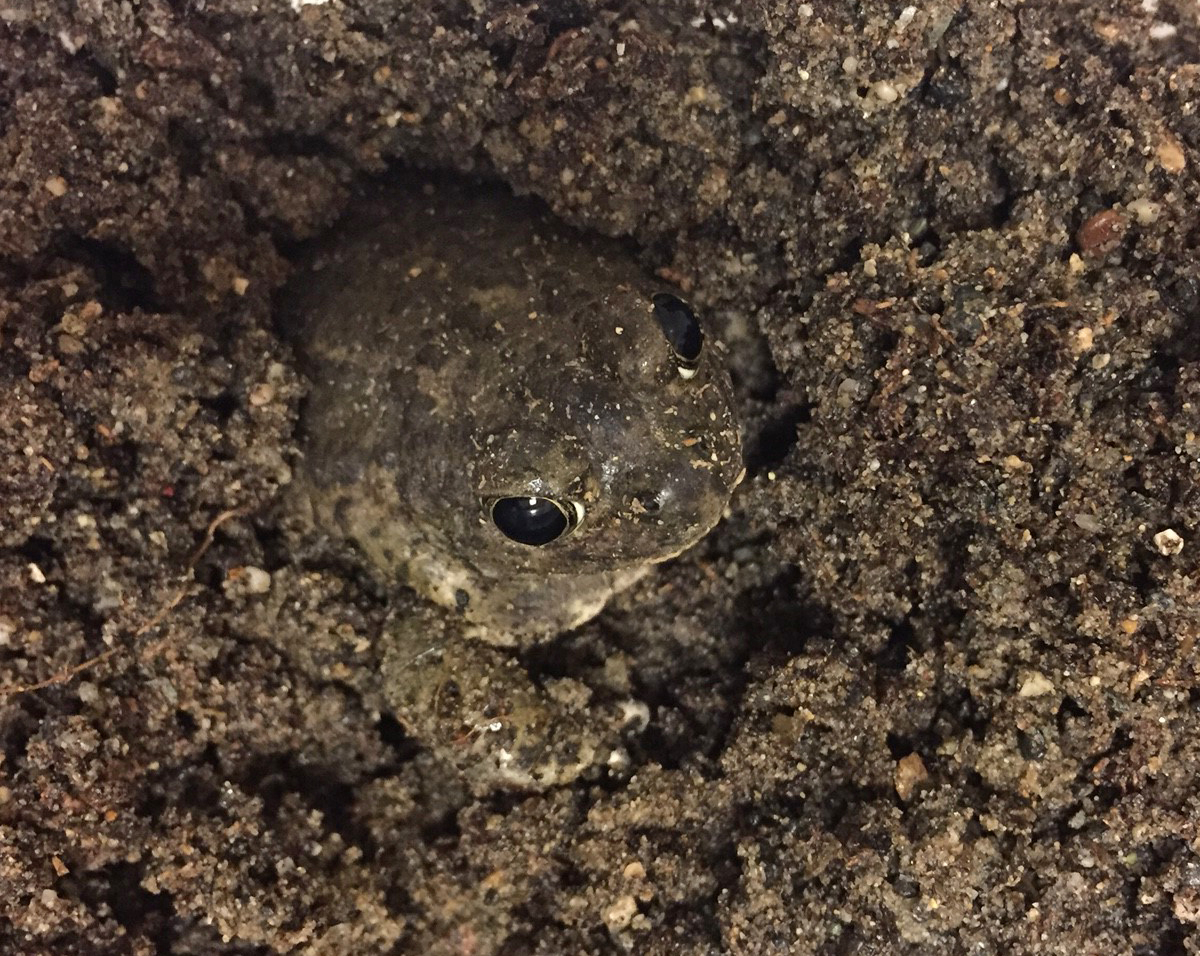
~ Great Basin spadefoot (Spea intermontana) (here in the Methow, in the shrub steppe, from Winthrop south, also in open ponderosa pine with seasonal ponds)
Bufonidae – True toads
Large, complicated family with a variety of development strategies.
In NW:
~ Woodhouse toad (Bufo woodhousii) in south eastern WA
~ Western toad (Bufo boreas) in the Methow. Stripe down back, black spots on belly. Digging tool on back foot for burrowing, or they use rodent burrows. They are early breeders up high in the mountains.
Hylidae – Tree frogs / chorus frogs
 |
| Tree Frog Eggs |
One of the largest families, very widespread, distinct wider adhesive toe tip.
In NW & in the Methow:
~ Pacific chorus frog (Hyla (or psudacris) regilla) use a wide variety of habitat, just need water source, wide toes at end, black stripe from tip of nose to shoulder, dark triangle on head (can change tone of color). They attach eggs to vegetation in lakes/ponds; they are relatively small in size (enlarge with age).
Ranidae – True frogs
Huge family (1377 species), worldwide, arid to temperate to tropical. Huge size range.
In NW:
 |
| Columbia Spotted Frog |
~ Columbia Spotted Frog (Rana lutieventris) In Methow. Red underside on legs; dorso-lateral folds; breed in shallow warmer water; lay big egg clusters communally; eggs often get algae on them, and get frothy-looking.
Salamander (Urodela)
585 species, 10 families (5 in WA/OR)
The Ambystomatidae family is known as the "Mole Salamanders."
Individuals can either metamorphose (change from eggs to larvae to adults), or be obligate "paedomorphic" (retain larval traits) individuals. They typically migrate to breeding habitat in large numbers. Terrestrial adults have robust bodies and limbs, and short, blunt heads.
In the Methow:
 |
| Tiger Salamander |
~ Tiger Salamander (Ambystoma tigrinum). Found in the shrub steppe and ponderosa forest. Eggs laid singly on vegetation in the water; larvae have long gills
~ Long-toed salamander (Ambystoma macrodactylum) Yellow stripe down back, eggs in parallel clusters.
In WA:
~ Northwestern Salamander (Ambystoma gracile). West of Cascade crest. Softball-sized egg masses. Mostly underground when on land; need moisture. Rib-like grooves on head; have perisoid glands (poison).
The Dicamptodon family are the "Giant Salamanders." They are endemic to PNW and there are 4 species OR/WA.
The Salamandridae family are called "True Salamanders"
They are mostly in Europe and Asia, except newts, which we have here in the PNW.
~ The Rough Skinned Newt (Taricha granulosa) Dry to the touch when terrestrial, but become slimy and develop dorsal fins in water where they go to breed; they are toxic and it's a good idea to not touch them!
 |
| Rough-Skinned Newt |
Terrestrial; are in wet areas but not in water. They are the most diverse. Nasolabial grooves (skin folds) help with chemoreception. There are 4 genera in Western Washington.
The Rhyacotritonidae family are the "Torrent Salamanders" (aka the Cascade salamanders. Rhyaco = stream, triton = greek sea god. They are endemic to the PNW; typically up high in watersheds. They are small and semi-aquatic.
Amphibian disease and toxicology with Jennifer Zajac
1/3 of all amphibian species are threatened (43% are in decline); 168 species have already gone extinct. There are multiple causes: habitat loss, pollution, invasive species, disease, etc.
Diseases:
Chytrid fungus (Bd)
Caused by a pathogen Batrachochytrium dendrobatids, which uses keratin in skin of amphibians and the mouth-parts of larvae, leading to low electrolytes in the animal and eventually cardiac arrest. The motile zoospore stage swims and is viable in water for 7 weeks without a host. Symptoms include lethargy, sloughing of skin, abnormal resting poses, loss of righting reflex, seizures and death.
Worldwide, it is thought to have originated in Japan, where it has little impact. There are different impacts in different areas on different species, but has led to serious decline in some areas, such as Central America.
Frogs and salamanders are both carriers, but frogs are more susceptible. Testing is done with a swab of the skin, legs, and feet to pull spores, which can be counted to tell severity of infection.
Chytrid has been found in Washington, but not much sampling has been done in the state.
Batrachochytrium salamandridrorant (Bsal)
Only affects salamanders; causes skin lesions; can be cured by holding critters at 25°C for 10 days.
Originated in eastern Asia on fire-bellied newts in the pet trade in 2013; currently only in Asia and Europe. Legal action is ongoing to try and keep it from the U.S.
Rana virus (RV)
Affects not only frogs, but fish and turtles, too. There is now global distribution as a group of different viruses. Leads to swelling of legs and body, hemorrhaging redness, white plaque in mouth (turtles), lethargy, and erratic swimming. It is lethal mostly at the larval stage, and 90% die off in 1-5 days. Man-made stressors such as pollution increase susceptibility.
Frog deformities (e.g. multiple hind legs)
Debated causes include: UV contamination, agrochemicals, parasites, trematodes, combination of those, but now it is believed to be from trematodes (internal parasites such as flatworms). More fertilizer leads to more snails leads to more birds leads to more trematodes leads to more deformities.
Toxicology: Susceptibility of animals to chemicals
Pesticide drift: chemicals from farmland drift, even to remote, seemingly pristine areas
The term "LC50" is the "lethal concentration" for 50% of study population.
Jen’s research looked at the interactive effects of chytrid, triclosan (ag chemical), and predatory effects. Triclosan is an antimicrobial used in MANY products, and found in 50% of US streams. She looked at Woodhouse toad tadpoles and the synergistic effects of these stressors.