From Frogs, Logs, Dogs, Slogs, Bogs, Hogs, and Pollywogs - It's the Methow Conservancy Blog!
Occasional posts - from the quirky to the momentous - on the life and times of the Methow Conservancy.
(What you won't find in E-News)

Thursday, September 20, 2012

Geology of the Pacific Northwest with Eric Bard -- Class 1 Notes

By Keith Douville, student in the class
 

Geology of the Pacific Northwest is the latest course offered by the Methow Conservancy.   Hosted at the new Methow Valley Interpretive Center in Twisp, this class is very popular and 25 eager students excitedly filled the center this Monday to learn about the mysteries of our area that lie hidden beneath our feet.  Our instructor, Eric Bard, began our geologic time travel adventure with a big picture look at some of the forces and their effects on this region. 

Our class, rocking on!
In my first attempt at a blog, I will document parts of this class in the hopes of allowing you to take part in it with us.  I will do my best to discuss concepts presented but encourage you to continue this work with further reading and inquiry as I am somewhat of a novice to the physical sciences.  I will include links for you to explore at the end of this blog.

The Pacific Northwest is a very young place, geologically speaking.   The land around us did not form until Jurassic Time, and since that period a great number of very complex changes have taken place.  This makes understanding of our local geology a complex task.  While this may make some cringe at the daunting task of making sense of it all, it is really a blessing for geologists both professional and amateur to have opportunities to unlock mysteries as theories develop and change with each new breakthrough in scientific understanding.  Part of the challenge (and fun!) for beginners like me is to think of things on a geologic time scale based on millions of years. 

One of the first concepts to understand as we discuss geologic history is the theory of plate tectonics.  Our earth has a crust of solid land which floats upon a plastic-like liquid mantle of molten rock.  The molten rock of the mantle moves as heat is dissipated into the cold of space; much like boiling water in a pan circulates.  This movement of the mantle causes shifts in the earth’s crust, and rifts form in the crust causing tectonic plates to form.  When plates move, they collide with other plates in predictable ways.   Convergence occurs where plates collide, causing buckling or subduction when heavier, denser, older plates under the ocean sink below lighter plates of the continent.  In other situations plates slide and slip laterally against each other, known as a transform boundary.  Plates which are converging at one point are diverging at others, allowing extrusion of the mantle and formation of new crust material.  The movement of plates is slow and constant, at about the same speed that our fingernails grow.  Occasionally plates get stuck and pressure builds, until a breaking point is reached and sudden movement (an earthquake) occurs.  The deepest and strongest earthquakes occur at subduction zones.  Convergent plate plate margins are considered to be active margins as is the Pacific NW due to subduction off the west coast. 

Prior to the formation of the Pacific Northwest, supercontinents made up of the large land masses of the world existed.  We do have some ancestral rocks from this time such as dark gray argillites found in the Colville area and east into Montana, and isolated outcrops of gneiss in the Pacific Northwest - especially along the eastern fringes of Washington.  The supercontinent Rodinia rifted near the modern Spokane area, and that is where the west coast of the ancient continent of Laurentia (North America) met the oceans at a passive margin.  The supercontinent of Pangaea eventually followed, and the Atlantic Ocean began to form as North America pushed to the west.  The early Rocky Mountains formed to the east due to active subduction of what was known as the Farallon Plate during the Mesozoic Era.  This marks the beginning accretion phases of Pacific Northwest geology, a very important concept.   During these accretion events, geologic terranes collide and form, adding to the west coast of North America.  The Kootenay arc was a deformation event with rocks folding and buckling under the pressure.  Because this was a coastline, many of these rocks are made up of marine sediments that had eroded from the landform of Laurentia.  Eventually this now active margin of western “North America” became magmatic and this true volcanic arc further fragmented earlier evidence of prior time periods. 

Now into the Jurassic time period with an active margin on the west coast of North America, it is time to begin adding land – and lots of it – to create much of the Pacific Northwest as we know it today.  The Omenica episode came first with the Aleutian-like Intermontane Belt of stuck together islands crashing into the westward-driving North American continent.  This collision ended the Kootenay arc and created a new subduction zone again on the new west coast with an associated volcanic arc.   In our immediate area, our piece of the puzzle is known as the Quesnella-Oakanogen subcontinent or geologic terrane.  The volcanic arc associated with this collision allowed intrusive granite plutons (pockets of slowly cooling magma underground) east of the Pasayten fault such as the Loomis pluton, Toats coulee, the green rocks of Knob hill above Palmer Lake (these are volcanic metamorphosed basalts), and later Oval peak and the great Goat Wall.  Deformation of rocks associated with the collision occurred as well, and uplifting of lighter limestones is evident in the landscape, with marine fossils in pockets as well.  As volcanic activity increased along the new islands forming the western margin of the continent (which was the trailing margin of the Intermontane Belt), erosion from mountains both east and west caused thick sediments up to 4000 meters thick to fill what became the Methow basin. 

This pattern continues again and again, adding new lands to the west of the Methow, in each case with subduction, volcanic arcs and magmatic intrusions, erosion and sedimentation, uplifting, and faulting causing an immense variety and complexity to the landscape.  The geological landscape changes rapidly in relatively short distances, and this landscape is further changed by glaciations.  Because loose rocks have been moved far and wide from their original positions by ice, it is important to look for bedrock outcroppings as you interpret the geology of an area, and recognize that anything smaller may have travelled from far to your site to confuse you. 

In a very general summary, the lands in the Pacific Northwest west of Spokane area formed very recently from our North American plate crashing into the oceanic plates again and again.  This highly dynamic process has given us a varied and interesting and complex landscape of unique geology, but one that is fascinating to interpret.  Next week we will take a deeper look at the rocks of the Methow area and see what kind of story they can tell us. 

Further Reading:
Evolution of the Pacific Northwest, an excellent free text!  http://www.northwestgeology.com/
Paleomap Project:  http://www.scotese.com/
UC-Berkley Geologic Time Scale: http://www.ucmp.berkeley.edu/help/timeform.php

Keith has spent his first summer working on the Beaver Project crew here in the Methow Valley and he's eager to learn all he can about this amazing place.

Thursday, September 13, 2012

Recycling at its Best

My husband (Cliff) & I went to Sunny M Ranch over the Labor Day weekend to remove & recycle an old wooden cattle feeder that was no longer needed.  Cliff has been using recycled barnwood for some of his woodworking projects, so the offer of more barnwood was appealing.

While we were there, Jennifer Hover introduced us to Jamie, a 14 month old Scottish Highland Bull who weighs 600 lbs.  He will be full grown at 6 years at approx. 2000 lbs. and will eventually be used for breeding their cattle.

Highland cattle are a Scottish breed of cattle with long horns and long wavy coats which are colored black, brindled, red, yellow or dun. The breed was developed in the Scottish Highlands and Western Isles of Scotland.  The beef produced by pure-bred Highland cattle is exceptionally tender and of high flavor.

The meat tends to be leaner than most beef because Highlands get most of their insulation from their thick shaggy hair rather than subcutaneous fat. The coat also makes them a good breed for cold northern climates.

While at the ranch, we also meet Petunia who had 12 small snow white, hungry piglets.  Peony is expecting shortly.

Recycling is even better if you can reuse the barnwood & give it new life.  It is fun to see the wood in the rough & then transformed into a piece of furniture.
 
It was a productive, enjoyable morning outside & being on the ranch reminded me how thankful I am that the Conservancy is preserving farmland in the Methow Valley.

-- Joy Schwab, Bookkeeper

Joy spends her days making sure our books and finances are up-to-date and accurate.  She's amazing!  When she's not running numbers she's biking, skiing, or hiking the hills!


Wednesday, August 29, 2012

The Home of My Heart

By Mary Morgan, Membership Assistant

I just returned from a fabulous week sea kayaking off the west coast of Vancouver Island with my husband Phil.  On the return trip, as we drove many miles down Vancouver Island towards the ferry at Nanaimo, I started musing on when a wonderful place becomes a great place to call home.  Although a very different type of environment, I had just spent a week in a place that has many of the same characteristics that the Methow Valley holds.

Incredible scenery, wonderful wildlife, fantastic recreation, engaging people.  Maybe even a few more characters than the Valley, if you can believe it!!

My favorite characters were of the animal variety.  Sea otters abound in this area, and display a great deal of curiosity towards those they encounter. This mom and pup were alert and wary, but not too concerned. 

The most exciting encounter occurred during the middle of the night.  As we were sleeping in our tent, a sound awoke us from the beach.  Phil checked it out, no sign of problems.  As we tried to go back to sleep, a wolf began howling, less than 100 yards from the tent.  Properly alert, we remarked on how lucky we felt to at least hear a wolf!  Again we attempted to go back to sleep.  Just as I started to drift off, a low growl came from just outside the tent.  After a brief scream on my part, Phil bolted awake, found his headlamp and checked outside the tent door.  Less than twelve feet away, a wolf was strolling by, looking slightly disgusted at the attention.  Needless to say, it took a long time to go to sleep!

We obviously love the outdoors – it has been an important part of our lives for the past 30 years.

Phil and I first came to the Methow in the early 80’s, drawn by the terrain.  We were cross-country skiers, looking for beautiful places to ski.  We loved to wander in untracked snow on the Methow hills.  We spent our honeymoon at Sun Mountain in 1982, and saw a cougar in a parking lot at a trailhead that later became part of Pine Forest.  By 1994, we had bought “recreational property”.  By 2001 we were building a cabin.  And by 2007, we had moved here permanently.  I tell people we came for the recreation, we bought property for the beauty, but we moved here for the community.

We found people who had a love for the Valley that matched ours.  Lots of quirky ideas, notions that didn’t always seem to make sense, politics we tried to not discuss!!  We love to travel and have seen many wonderful places, but when we return, I always experience a profound sense of peace as we drive back into the valley.  A strong sense of coming back home that is hard to explain since I didn’t grow up here.

But as I was traveling through the waters off the coast of Vancouver Island, I was reminded of what that love of place is all about.  One of my favorite memories of our recent trip was the ride back in a boat provided by a member of the local native band.  LeRoy is probably in his early 20’s, grew up in Kyuquot,  a village on the west coast of Vancouver Island that is only accessible by floatplane or boat.  His dad runs a water taxi service that takes kayakers out to the more remote Islands.

As we headed back to the dock where our car was located, LeRoy mentioned that there were a lot of humpback whales in the area.  Phil said he would love to get some photos if we encountered more whales.  LeRoy grinned and said, “I think we can do that!”

Soon he spotted spouts in the distance down a side channel.  LeRoy pointed and said we could go around the Island on our way back to the dock, if Phil wanted photos.  We quickly agreed.  As we approached the whales, LeRoy throttled back, and drifted closer.  We watched this wonderful humpback whale surface, spout…. surface, spout…. surface, spout.  And then he lifted his tail high, and plunged deeply into the water.  LeRoy and I turned to each other with huge grins on our faces.  I said “magical”!  And he said “yes”!!!  His connection to his place was so real I could feel it. I’m sure he’s seen humpback whales countless times in his life, but it is always magical for him, and he loved sharing it with me.

I love the Methow.  It is the home of my heart.  I wasn’t born here, but I chose this place because of the huge connection I feel to it.  That is why I work at the Methow Conservancy.  My work helps keep this place the magical home that I have found.  What I do isn’t fancy – but it is a small part of what allows the Conservancy to keep the Valley the home I love. 

I love going away, but I love coming home the most!


Mary Morgan wanders into the Methow Conservancy office on Mondays to process donations, send out acknowledgments to our many donors and help with the other tasks that keep an office running.  The rest of the time she is playing with her husband Phil, dog Luke and backpacking with friends in the Pasayten.

Wednesday, August 22, 2012

Hanging out with Dora the Explorer


by Hannah Hogness, 
Methow Conservancy Summer Intern and rising Liberty Bell High School Sophomore

Dora the Explorer
Applying for the internship at the Methow Conservancy this summer, I knew I would be doing some fieldwork, but did not know what to expect. In my 15 year old mind, I painted a pretty hard-core picture: sharp machetes being used to clear new trails, plant inspections and property observations from dawn till dusk. Fortunately, machetes were not needed. On my first day doing field work, we went to two properties between Highway 20 and the Methow River, near Mazama. Mary Kiesau and I parked at the first property. Here, I made my first observation; Mary’s bag. Stuffed to the max with a compass, GPS unit, cameras, notebooks, food, water and other supplies she reminded me of Dora the Explorer. Extreme Dora the Explorer. To this day, Mary still remains a Dora to me and will be referred to as Dora throughout this article.

Continuing on our first property, Dora explained how each conservation easement has certain GPSed “photo-points” that are returned to annually to be photographed. Walking down the road, Dora pointed out the relatively tall strip of grass and weeds growing in the middle of the road. “Fire risk” she explained. “When cars drive over tall, dry vegetation, the heat from the car could potentially set the dried grass on fire during the hot summers.” I made sure to trim down the strip on my road before any Conservancy people came to pay me a visit! Once we reached the land owners house, we talked to him about what he’s noticed, any changes he had made or was planning on making to the property and if there was anything we should know. After that, we went on our adventure to find the photo points. Arriving at the points one by one, we used the photos from prior years to pin point what we were taking pictures of. The main photo points were on the borders of the property. Dora explained later that one reason the Conservancy does that is to make sure neighboring property owners aren’t accidentally disturbing the conserved land. Finishing the day after about 3-4 hours, I looked through some of the photos and compared them to the ones from a couple years ago. The two properties we visited that day had both changed vastly: little aspens growing into large ones, and small shrubs sprouting into large bushes along the river bank, which is good for erosion prevention and stabilizing the shoreline.

Taken in 2002, note the view of the river to the right.

The same photo in 2012, note the vegetation growth, plus many small trees have cages on them.


Pinedrops, a cool plant in the woods
The next time I accompanied Dora on a field work expedition was in mid August. It was much hotter than before and we had two larger easements to monitor. Somehow one property managed to take up five hours! These conservation easements were located up the Twisp River, and they both featured river shoreline, fallow agricultural fields as well as thick forest and brush. During this monitoring visit, the property owners joined us and walked us to the designated photo points, which was helpful since they knew how to get around the large property better than we did. Throughout the walk, Dora explained to me why the Conservancy monitors properties. When the landowners sign the conservation easements, which are permanent, they are agreeing to certain restrictions in order to protect the land. Restrictions vary from easement to easement because easement vary greatly in size and land type (farm land, river land, forest land, etc.).  For instance, most easements don’t allow off-road vehicle use or the development of any new roads; some don’t allow any new homes, though some do; some require that forest management be done. Dora explained that when we are monitoring, we are not just taking the photo-points, but we are also looking for both positive and negative man-made and natural changes to the land since the last visit. Changes could be whether irrigation is happening, if weeds are increasing and decreasing, improvements in the river banks, or other ecosystems. Finishing up our field work for the day, at the peak heat of the day, Dora and I decided to go for quick dip in the frothy Twisp River.

Scarlet gilia on a river bank in June
Throughout my work for this internship for the summer, field work definitely stuck out to me as something I looked forward to. Field work gave me the opportunity to learn about different plants, birds, and environments here in the valley. Thank you Methow Conservancy for the wonderful internship experience!

Tuesday, August 14, 2012

Everett, Micah and Tundra Wow First Tuesday Crowd
by Morgan Tate and Amaya Gracie, 
Methow Conservancy Summer Interns and Liberty Bell High School Students
Jessica Graham with Everett the American Kestrel
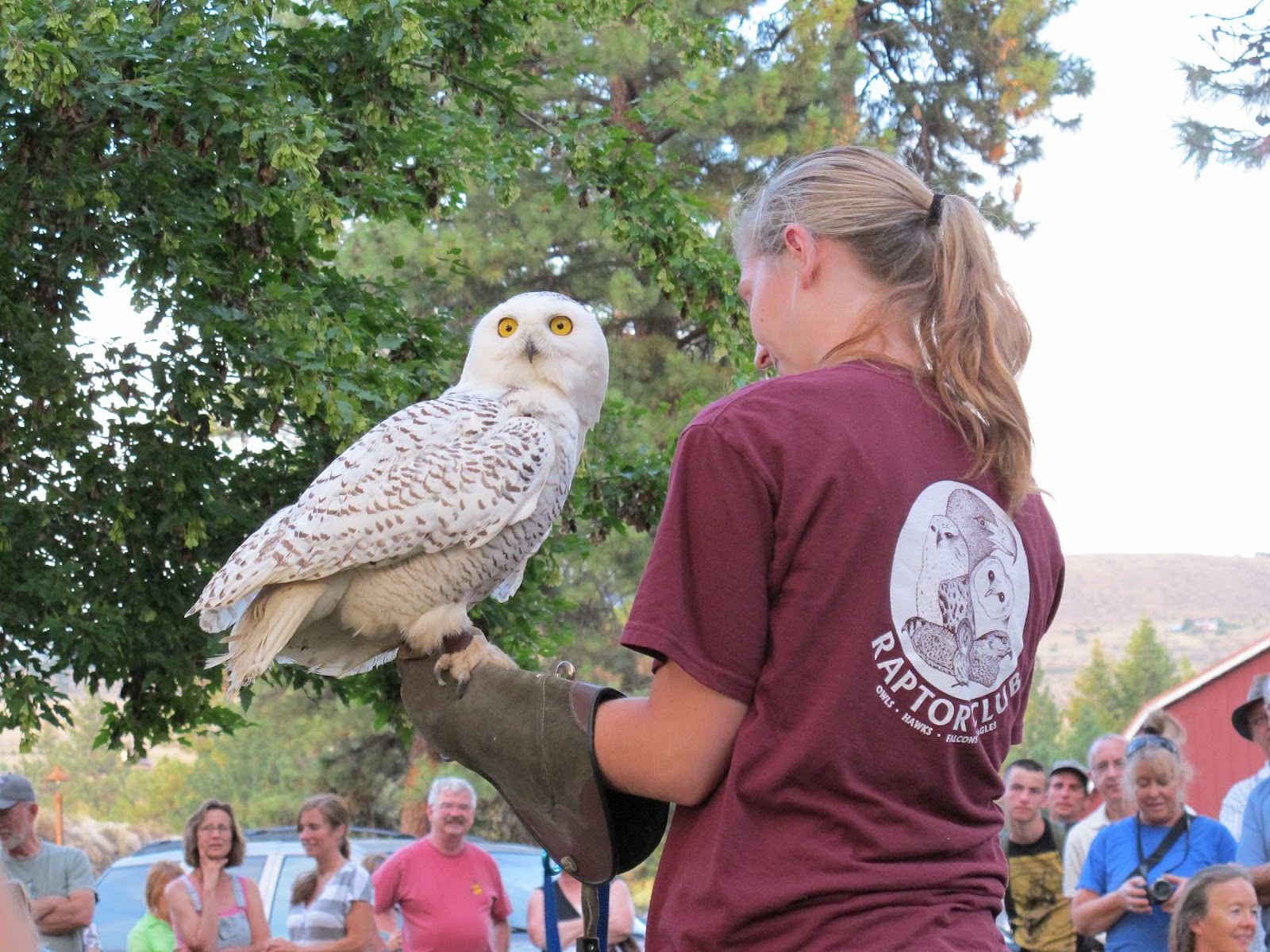
At the Methow Conservancy’s August “First Tuesday” program on August 7th, Winthrop was visited by the WSU Raptor Club. Their representative, Jessica Graham, who is the current president of the organization, brought along three birds to show us all a little of what she does at her school club in Pullman. She explained how every bird in their care has some sort of disability that results in them not being able to survive in the wild. An example could be losing their ability to fly, as were all of the birds she brought with her. They strive to return each bird back to full health even though they live in captivity.

The Raptor Club has a varying number of 50-75 active club members who all share an interest in working with birds of prey. It began without live raptors, but presently has 16 raptor residents, including the American Kestrel, Northern Harrier Hawk (aka Marsh Hawk), and Snowy Owl that accompanied Jessica. The American kestrel, named Everett, is a falcon, a type of raptor. As she walked around with him perched on her hand, protected by a leather glove, she revealed her vast knowledge of bird facts, both in general and pertaining to Everett. American kestrels are known for their sharp, fast dives and ability to see shadows from UV light giving them the upper hand when finding prey. Other falcons, such as peregrine falcons are known to decapitate ducks in mid flight.  Kestrels are also the smallest falcon in North America, measuring at 19–21 centimeters (7–8 in) long. All falcons have something called a “tooth-notch” on their beak, allowing them to insert their beak into the spine of their prey and break the spinal cord.  These birds may be small, but they sure can be fierce!

Next up was Micah, a Northern Harrier who was hit by a combine before he had fledged from his nest in a field. His wing was so badly damaged, it had to be amputated. Since his accident took place at such a young age, the Raptor Club was hopeful that he would learn to balance without the weight and support of his left wing. At almost two years of age, he has succeeded in adapting to his disability. 

Micah had his left wing amputated when he was young but he's managed to learn how to balance.
The third and last bird Jessica introduced us to was Tundra, a fully grown Snowy Owl. The crowd was amazed at her fluffy white face and huge yellow eyes. She was found near Spokane, WA last December, and the club adopted her at 6 weeks old. She suffered from a humeral fracture and dislocated elbow. If not for the dislocated elbow, which no bird can recover from, Tundra would be able to fly, and even carry an animal up to half her weight. We learned that owls have serrated feathers, like a comb, to give them silent flight and help them sneak up on prey. After playing a guessing game, we found out that the large owl weighed only three pounds due to hollow bones for flight advantages.

Most people believe that owls can turn their head in a full circle around themselves, but, in fact, they only have a 270 degree rotation (which is still amazing!).  This is because they have 14 vertebrae rather than seven, like humans. They need the extra rotation of their head because their eyes are so big that they can’t move them the same way we can move ours. If humans were to have the same scale as owls do between the size of their eyes and their head, our eyes would be the size of oranges!

Tundra, a female Snowy Owl.  Females have brown flecks in the feathers whereas adult males are all white.
 After each birds’ show-and-tell, the 200+ people in attendance asked dozens of questions.  People were amazed with Jessica’s knowledge and the accomplishments the Raptor Club had made and were interested to learn more. Children asked question after question while adults awed over Tundra’s massive talons. The Raptor Club presentation was a huge success. In only one short hour, someone who knew nothing on birds became a fascinated learner, ready to discover what part he or she could play in saving another raptor.

Saturday, July 21, 2012

Field Class Stories from our Summer Interns!

Butterfly Excursion to Harts Pass

by Morgan Tate, 
Methow Conservancy Summer Intern and rising Liberty Bell High School Junior

A group of butterfly-lovers joined together on July 11th to search out as many butterfly species as possible. Harts Pass had a bluebird sky and a warm breeze; the perfect day to be skipping along with a butterfly net. On this excursion, I was surrounded by many people who knew a lot about butterflies. They were able to snatch up a Northern Checkerspot and identify it with a swish and a glance. I, on the other hand, struggled to capture anything with my camera lens. I eventually had to settle with the grounded butterflies.

David James, the leader of the group, was able to help us “newbies” notice the slight differences between the insects as well as catch them. The differences could be in antenna color; white vs. black and white stripes, or perhaps a different number of spots on the wings. Anything could be a sign, and there I was attempting to take it all in during one trip.

Northern Checkerspot
We traveled up the road towards Harts Pass and then back down, stopping at four main places, with a couple of random stops too. We tried to find the most open areas because butterflies enjoy the sunshine. In total, we found 19 species of butterflies. I feel that the most common were the Northern Checkerspots (Chlosyne palla) and Northern Crescents (Phyciodes cocyta), but my favorite was the Lilac-Bordered Copper (Lycaena nivalis); the ends of its wings were tinted lavender. 


Northern Crescent
At some point, we all noticed that most of the butterflies were smaller that average. David James said that the caterpillars probably had less food the previous fall before hibernation.  Once, the "hatch" as butterflies, they are the size they are going to be - they don't grow.  He also mentioned something I never knew but was completely realistic; however big the caterpillar was, is how big the body of the butterfly will be. Butterflies don't grow after being in the chrysalis. Fun fact!

The Clodius Parnassian was big and beautiful
In the second spot, we were surrounded by forget-me-nots and lupine. There, we found a great deal more of Northern Checkerspots and Northern Crecents. At the end of the road (we were stopped because of snow between Harts Pass and Slate Peak) we ate lunch and had a stunning view of the Cascades, and we all looked around in amazement at the spring flowers. It was as if we were in a time warp, sitting in a field of glacier lilies and spring beauties. Our last spot granted us with the 19th species: the Purplish Copper (Lycaena helloides).

After this experience, I will never be able to look at a butterfly the same way again. I will begin to search for certain spots or markings that define who they are. Thank you David James for broadening the horizons of my young mind!

Me at Harts Pass enjoying the glacier lily and amazing views!


What's in the Water?

by Taylor Curtiss, 
Methow Conservancy Summer Intern and rising Liberty Bell High School Junior

Last Saturday I attended a Stream Ecology and Aquatic Macroinvertebrate class. I arrived hoping to learn more about the waterways in our valley, and be able to recognize certain macroinvertebrates. When I left the class I took away much more information than I expected. I learned about the food chain in the rivers and that if too many nutrients are being produced, which could be a result from a septic tank leaking, there will be more nitrogen in the water. I’m also able to identify a stone fly, caddisfly, a mayfly, and the differences between these three macro invertebrates. The teachers of the class, Rick Haley and Tim Hall taught us some new biology terms such as thalweg, which mean the main channel of the creek/river, which is usually also the deepest part. Another new term is imago which is the name for the adult winged form of an aquatic insect.

Here is a picture of a stonefly. You can tell that it is a stonefly because of its two tails, whereas most mayflies have three. The antennas on stoneflies are also much longer than the ones found on a mayfly, and stoneflies don't have external gills whereas mayflies do.

In this picture, our leader, Rick, shows the group how to record the data that we took with his provided instruments. We measured the temperature of the water, the percent of oxygen in the water, the salinity (salt level) which was 0, and conductivity. Rick told us that the conductivity is directly linked to the total amount of dissolved solids in the water. This means that, in a way, we were measuring the amount of suspended solids (sediment/debris) in the water. The lower the number the better.  Some macroinvertebrates such as stoneflies and mayflies require a high level of dissolved oxygen and their abundance is an indication of good water quality.

After examining the river near the suspension bridge in Mazama, we made our way to Early Winters campground and learned how to examine a site to determine the well being of the area. We were each given a short report to fill out.  We had to describe the site visually, draw a sketch of it, and then answer a lot of questions.  Some were specific, such as, “What the water temperature?”, which we could answer from having taken the measurement, and some were more subjective, such as, “What percentage of vegetation shades the stream?”.  We then gathered into a group to talk about our answers and compare with the “pro’s.”

Being in this class has given me a lot more knowledge about the place we live in, and the river behind my house. I also feel better prepared for next year’s science classes in school.

Here are some fun facts that I learned:
•  When the water in the creeks/rivers gets warmer, the cold blooded animals need more oxygen because their “motor” is running faster but there is less oxygen available to them.
•  Salmon laying areas need fresh oxygen from moving water. It’s important that there is moving water because it provides oxygen and if there is any dirt in the water; chances are that the eggs will die

Sunday, July 15, 2012

Daylily Season

Daylilies outside our front door
This is field season for the Stewardship Team (Heide, Mary, Julie and me) at the Methow Conservancy and several times a week we are out in the 'field' doing either baseline surveys for new easements or annual monitoring visits at one of our 94 conservation easements. We work in a variety of habitats from dense riparian jungle, to mid-elevation ponderosa pine/Douglas fir, to dry shrub-steppe, to Valley floor farmland. Each day is different.

At the end of each of those days I come home to my green, irrigated yard and for the past week to some brilliant orange daylilies that are right near our front door. When I see them I smile and remember our beloved neighbor Fran. Every time  we walked past this same clump of lilies Fran would tell me that when she was a little girl, her dad would pick the flowers and make soup out of them.

Fran grew up on a farm on Vashon Island, the oldest of 8 siblings. Her family raised chickens, vegetables and fruit. They sold their produce at Pike Place Market. Fran's dad was Chinese and lilies are often used in Chinese cuisine. You can buy them in Asian markets as 'golden needles' or 'gum jum'. 

This family photo was taken on the farm on Vashon Island in 1930.  My neighbor Fran (Mary Francis) is in the middle.  The siblings that were born after 1930 were 'photoshopped' in a few years ago.


Fran worked many jobs in her lifetime and was often a farmer as well. She moved to the Methow Valley in 1968 when she and her husband bought what many of us think of as the VanderYacht Farm on the East County Road. They raised cattle there and had a big garden. Fran moved from there to the house next door to us on the Twisp-Carlton Road in 1983. She had a huge garden there too and tons of flowers which she sold at a little stand in front of her house. Many people knew her as the flower lady.  Fran is now 93 and in a nursing home on the Westside. We miss her every day.
Fran at the Methow Valley Farmer's Market about 10 years ago.

Here is one of many recipes for Chinese Daylily Soup (a vegetarian version). I do not know what Fran's dad put into his version. I wish that I had asked her.

Ingredients: dried daylily buds, black fungus, tomatoes, fresh ginger, shiitake mushrooms, olive oil, soy sauce, white pepper.
1. Soak a handful of dried daylily buds and a handful of black fungus half an hour in advance.
2. Cut a couple of large tomatoes into large wedges.
3. Slice a 3-inch piece of fresh ginger and fry it lightly in olive oil.
4. Add shiitake mushrooms to the oil and fry them until done to taste.
5. While they are frying, bring a pot of water (2-3 liters) to a boil.
6. Shred the soaked black fungus and drain the daylily buds.
7. Add the shiitake, fungus, buds, tomatoes and ginger to the boiling water.
8. Season with soy sauce and a dash of ground white pepper.
9. Reduce the heat and allow to simmer for 10-15 minutes.

I have never tried daylily soup, but I have a bunch of these lilies and I'm going to give it a whirl. I'm going to throw them into my next stir fry too.

- Dawn Woodruff
Monitoring Coordinator & Computer Nerd